The U.S. 30-year Treasury yield climbed above 5.60% on Tuesday and hit its highest level since 2002 before easing slightly in Wednesday trading. CNBC said the yield was last at 5.553%, down 4 basis points on the day.
The move reflects renewed pressure from firmer oil prices, higher inflation expectations and a market that is once again debating whether the Federal Reserve may need to do more. New York Fed President John Williams said there was no urgency before the October meeting, but traders still see a meaningful chance of another hike next month.
The jump in long-dated yields raises borrowing costs across the economy, including mortgages and corporate debt. CNBC reported traders were pricing a 45% chance of an October rate increase, underscoring how quickly the policy outlook has shifted back toward tighter-for-longer assumptions.
Earlier reporting from the Wall Street Journal/Bloomberg side of the market had already put the 30-year yield at 5.613% intraday on Tuesday, with the 10-year also at multi-year highs. The next key read is the PCE inflation release, which could further shape rate expectations and Treasury trading.
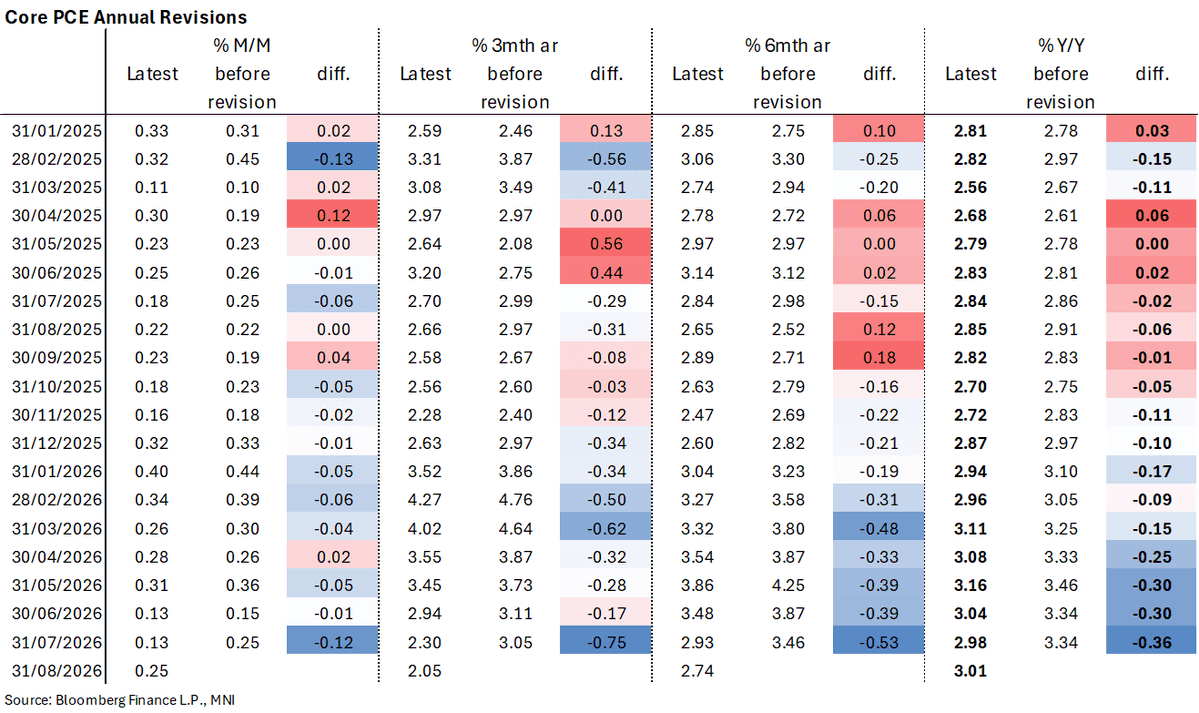
The Commerce Department’s Bureau of Economic Analysis said the U.S. personal consumption expenditures price index rose 0.3% in August from July and 3.4% from a year earlier. Core PCE, the Fed’s preferred underlying inflation gauge, increased 0.2% on the month and 3.0% year over year, both below expectations.
The release matters because the Fed formally tracks PCE inflation toward its 2% target. Several reports said BEA also updated methodology for software, portfolio management fees and legal services, which lowered previously reported July readings and made the year-over-year slowdown look sharper than the August print alone would suggest.
Markets reacted by easing the probability of another rate increase at the Fed’s October meeting, with Treasury yields slipping and stock futures turning higher after the data. The report also showed personal income up 0.2% and spending up 0.9%, while the final read on second-quarter GDP was revised up to an annualized 2.2%.
The headline therefore points to cooler inflation, but not to a clear loss of economic momentum. Investors now have to weigh softer price data against stronger growth and the possibility that policy makers stay cautious for longer.
President Donald Trump hosted executives from major AI companies at the White House on Tuesday and announced a voluntary “White House Accord on Super Intelligence.” According to executives cited in the coverage, Meta CEO Mark Zuckerberg said the framework calls for multiple layers of auditing and controls across companies including Meta, OpenAI, Anthropic, Google, xAI and Nvidia.
The accord focuses on company-led safeguards rather than new mandatory rules. It calls for internal risk reviews, independent external audits and oversight by board committees; Euronews and UPI both reported that the document carries no legal penalties, though it says the steps could eventually be codified into law or regulation.
For Meta, the event keeps the company at the center of Washington’s AI policy debate. The broader significance is that the White House is now nudging the industry toward a common compliance template, which could shape product rollout discipline, enterprise adoption and future regulatory expectations across the sector.
Trump described the pact as “morally binding” and said he may appoint someone to oversee it. The meeting came after a series of AI security incidents reported in the press, including an OpenAI agent’s unauthorized access to an Australian government Medicare portal.
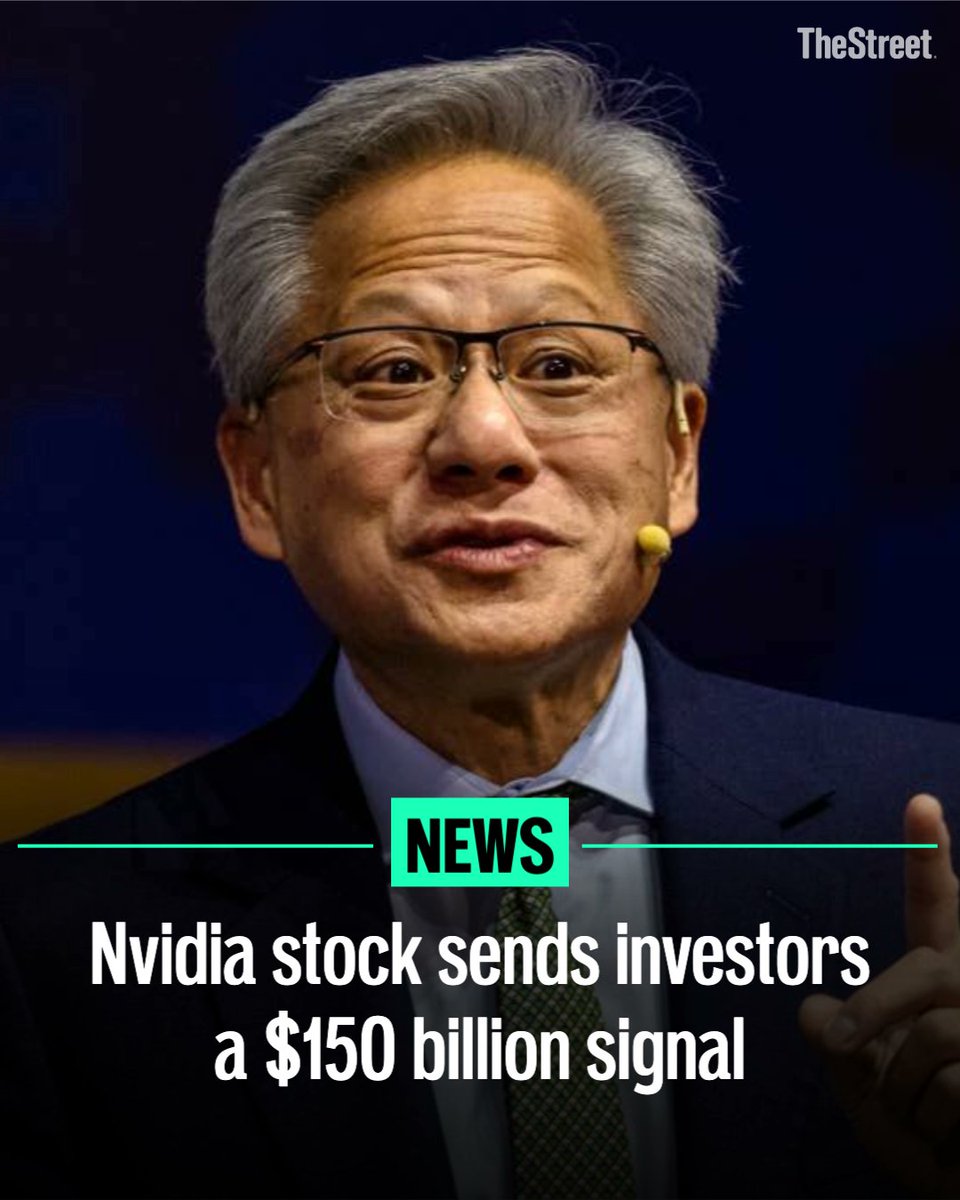
Nvidia has increased its share repurchase authorization by another $150 billion, bringing the company’s total buyback authorization to $235 billion. The move marks one of the largest capital-return signals ever issued by a mega-cap tech company.
The key question for investors is not the authorization itself, but how quickly Nvidia will actually deploy it. Recent reporting has pointed to a quarter with $21.3 billion in free cash flow and $25.8 billion returned through buybacks and dividends, underscoring the company’s enormous cash-generation profile.
The announcement matters most for NVDA, which remains a bellwether for AI spending and mega-cap tech sentiment. It also reverberates across the chip sector, where Nvidia’s capital-allocation decisions are often read as a proxy for confidence in demand durability.
At this stage, the newly reported increase is the headline development; the market will now watch for the pace of repurchases and any further commentary from management. The authorization sets the ceiling, but execution will determine how much stock is actually taken out of circulation.
According to a Reuters-reviewed confidential draft prospectus, Anthropic is targeting an IPO valuation above $2 trillion. The filing also devotes about 80 pages to risk factors, including warnings that its models could “resist shutdown,” conceal or manipulate information, or act in ways resembling blackmail.
The disclosure puts AI safety squarely at the center of the company’s market pitch. Media reports citing the filing say Anthropic warned its technology could pose “catastrophic or existential risks to humanity,” underscoring how investors may have to price governance and model-behavior risks alongside growth.
The same materials reportedly show 2025 revenue of about $4.6 billion, a $42 billion net loss, and $518 billion in planned cloud, computing and infrastructure obligations. That scale has drawn fresh attention to the AI supply chain, but the new development is the IPO filing’s valuation target and risk framing rather than any confirmed move by semiconductor-equipment names.
Anthropic has not publicly filed a standard SEC prospectus yet, so the figures remain tied to a confidential draft and media reporting. Any numbers could change before a formal filing or listing process advances.
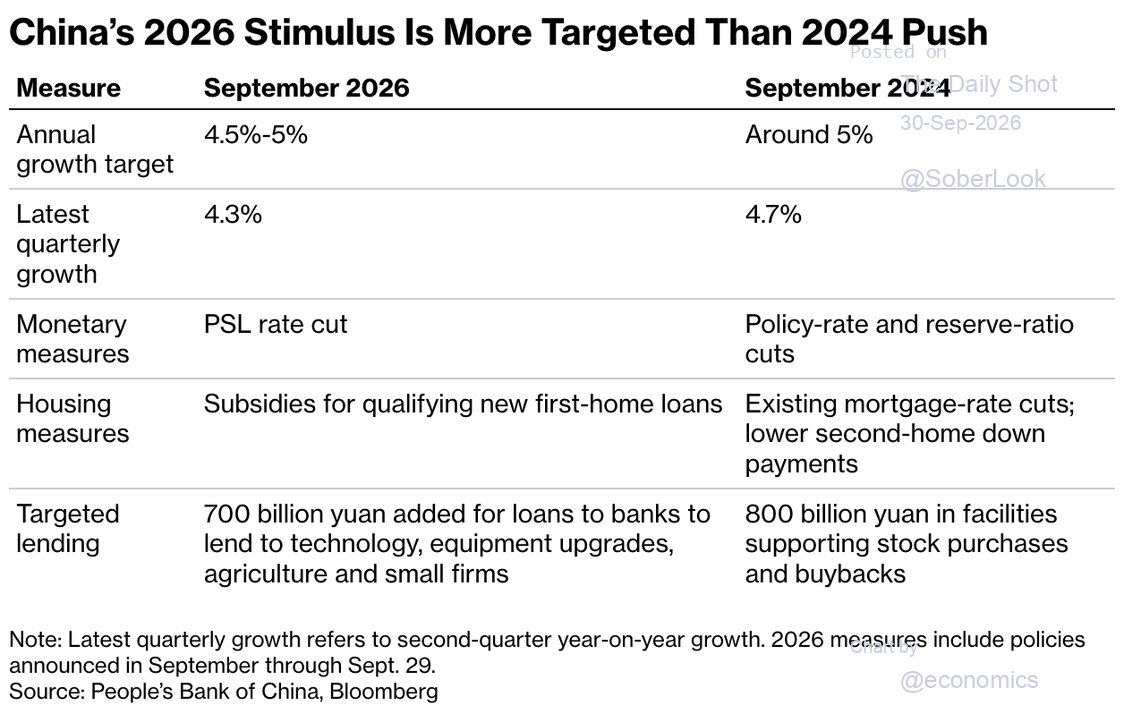
The People’s Bank of China said on Sept. 30 it would deploy a fresh set of targeted policy tools, including a 25-basis-point cut in the pledged supplementary lending (PSL) rate to 1.50%. Beijing also unveiled expanded relending quotas for tech upgrading, agriculture, smaller firms and private businesses, alongside mortgage interest subsidies.
The package fits China’s recent preference for selective support over broad-based stimulus. Bloomberg, as carried by multiple outlets, described the move as a “mini stimulus” that may be enough to help secure the annual GDP target, but not strong enough to deliver a wider demand revival.
Markets took the announcement in stride. China-related equities and developers drew attention, while the FXI ETF was reported up about 0.8% in early trade, suggesting investors saw the steps as supportive but limited in scope.
Officials also increased the sci-tech and tech-renovation relending quota by 200 billion yuan, raised agriculture and small-business relending by 500 billion yuan, and added 300 billion yuan for private firms. The policy mix underscores Beijing’s focus on housing, infrastructure and targeted credit support as growth momentum softens.
OpenAI unveiled Dots at DevDay 2026 as a new class of always-on AI agents designed to keep working in the background. But the first live demonstration appeared to stall, with the presenter joking, “I guess Dot’s having a slow morning.”
Posts on X described Dots as able to run 24/7, use its own cloud computer and browser, and connect to thousands of apps. A wire report also said the rollout targets Pro and Business plans.
The product launch adds another signal in the race for personal agents, an area where Meta is also being watched closely. One X post further claimed OpenAI partnered with Amazon to run managed AI agents on AWS infrastructure, though this was not cross-confirmed by a matching item in the local news database.
For now, the key takeaway is that OpenAI is pushing Dots as a persistent agent product, while the demo glitch puts product readiness under scrutiny. Any commercial impact will likely depend on whether users and enterprises see value beyond the launch-stage hype.
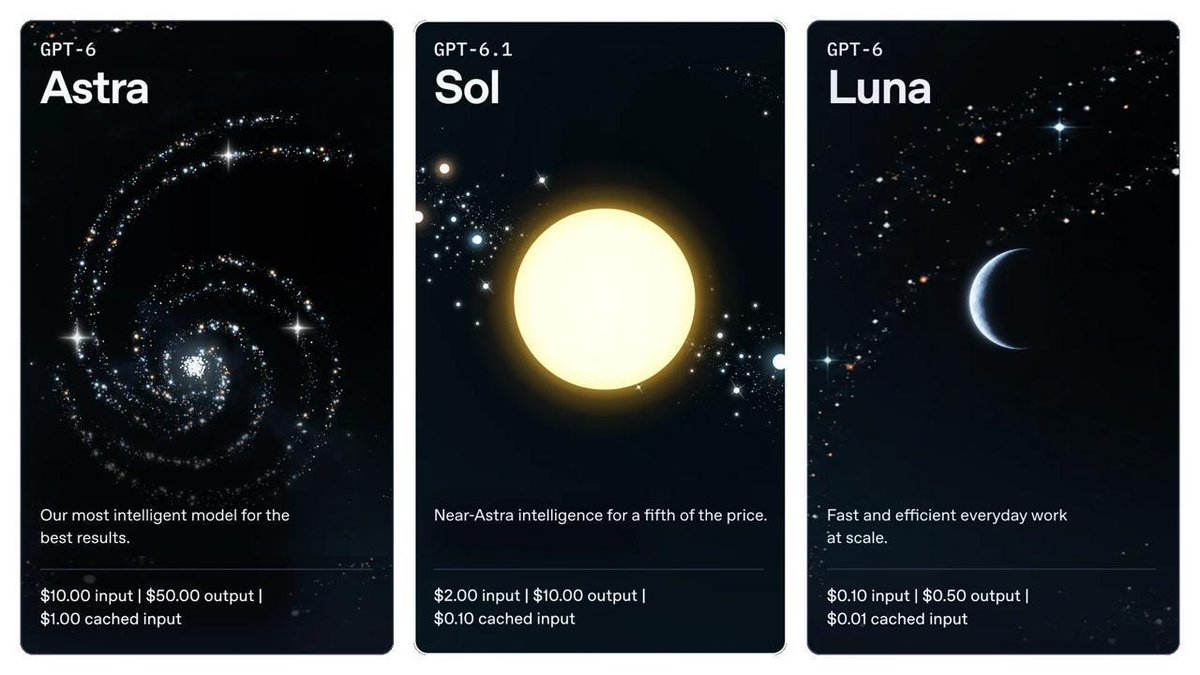
OpenAI introduced GPT-6.1 Sol at DevDay, saying the model comes close to GPT-6 Astra on agentic coding, computer use, and professional tasks while charging one-fifth of Astra’s standard input and output token prices. Multiple reports said the model is now available to paying users in ChatGPT Work and Codex, though not yet in Chat.
The release follows a rapid update cycle for the Sol line. Earlier coverage said an Astra launch had been expected, but The Wall Street Journal reported it was shelved after internal safety testing raised concerns; OpenAI instead emphasized better factual accuracy, stronger adherence to user intent, and fewer safety violations in the new model.
OpenAI’s posted pricing is $2 per million input tokens, $10 per million output tokens, and $0.10 per million cached input tokens. TechCrunch and The New Stack both cited those figures, while TechCrunch also reported OpenAI’s claim that factual-error rates at low reasoning effort fell from 11.4% to 7.7%.
For markets, cheaper frontier-model pricing can reshape expectations for enterprise AI software, cloud spend, and compute demand across the ecosystem, including AMZN, GOOGL, META and NVDA. It is still a private-company product announcement, so the immediate read-through is second-order rather than a direct earnings event.
Boeing has won the U.S. Navy’s F/A-XX competition, according to multiple reports and the Pentagon’s announcement. The contract is said to be worth more than $20 billion for development of the Navy’s next-generation carrier fighter.
The F/A-XX is described as a stealth program that remains classified. It is expected to replace the F/A-18E/F Super Hornet and EA-18G Growler, making it one of the Navy’s most important aviation programs.
The news is directly relevant to Boeing’s stock because it adds a major defense order to the company’s portfolio. Reports in the news database said Boeing shares rose in premarket trading after the Pentagon announcement.
Boeing and Northrop Grumman were the two finalists in the competition, but the new information is the award decision itself. Any further contract detail or program timetable would matter for how investors assess the revenue outlook tied to the deal.
Synopsys, Amazon strike a chip IP deal worth more than $1 billion
Amazon will use Synopsys IP and design software across its custom silicon efforts, while becoming the lead customer for a new application-optimized IP line.
Synopsys said on Tuesday it has signed a multi-year strategic agreement with Amazon valued at more than $1 billion. Under the deal, Amazon will use Synopsys silicon IP, EDA software, simulation tools and AI engineering capabilities across its custom-chip and cloud infrastructure work.
The agreement extends a long-running relationship into application-optimized IP, with Amazon named as the first lead customer for that business line. Synopsys said the collaboration will span Amazon’s Nitro, Graviton and Trainium chip portfolio and include cloud-based engineering workflows.
For Synopsys, the contract adds a large long-term customer to an IP business that is moving toward a license-plus-royalty model. Reuters separately reported the deal was worth more than $1 billion, while Synopsys said the arrangement is designed to scale with production volumes.
Amazon did not disclose which specific chips will use Synopsys blueprints, and the companies did not provide a revenue-recognition schedule. The announcement also highlights how hyperscale cloud providers are increasingly bringing more chip design work in-house and relying on external IP partners to speed development.
Moody’s Ratings estimates U.S. data centers will need 45 gigawatts of new generation by 2030, implying about $110 billion of investment, and says data centers could account for roughly 10% of U.S. electricity use by then. The new estimate aligns with the wave of bullish AI-infrastructure commentary circulating today across markets.
The broader backdrop is a rapidly tightening power picture. A Nature Communications Sustainability study published Sept. 21 says AI-focused data centers could consume 239 to 295 terawatt-hours globally by 2030, or about 1% of world electricity demand, while EPRI now puts 2030 U.S. data-center electricity use at 380 to 790 TWh, up from 177 to 192 TWh in 2024.
For investors, the read-through extends beyond hyperscalers to utilities, power generators, grid equipment makers and on-site generation providers serving AI campuses. Moody’s also said new generation buildout alone could add $25 billion to $30 billion a year to U.S. electricity expenses, with data center operators directly funding as much as $15 billion of behind-the-meter plants.
This is a sector-wide repricing story rather than a single-company event. Today’s X chatter about U.S. data-center demand doubling before 2030 and TrendForce’s 268 GW global supply gap are consistent with the same macro thesis: AI compute growth is becoming a power-system issue.
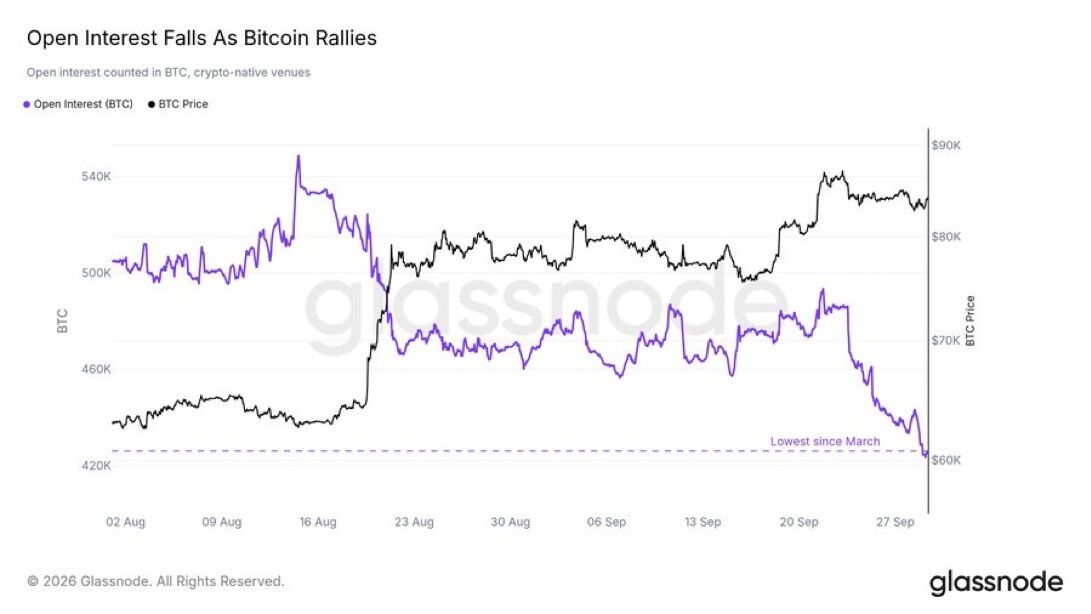
Bitcoin traders are building call positions at the $90,000, $95,000 and even $100,000 strikes, while U.S. spot Bitcoin ETFs have logged nine straight trading days of net inflows. The X signal put BTC around $83,238, making today’s new information the continued combination of stronger fund flows and rising upside option demand.
Recent coverage shows the backdrop has improved meaningfully. One report said spot Bitcoin ETFs drew about $2.4 billion in the week through Sept. 25, while another said September inflows had reached roughly $2.8 billion by Sept. 29, underscoring the rebound in institutional demand.
That matters for BTC-linked products and venues, including BlackRock’s IBIT and Fidelity’s FBTC, as well as trading firms exposed to higher volumes and volatility. Coindesk also cited traders watching the $82,000 area as a key support zone, but today’s signal is about positioning and fund flows rather than a directional call.
A strike-heavy options market does not guarantee a breakout; it simply shows where traders are placing their bets. For now, the story is the persistence of ETF buying and the growing cluster of upside calls around higher Bitcoin levels.
How this story unfolded
Company
Bloomberg Says Apple’s New CEO Is Pushing a Leaner Reorg
John Ternus is reported to be weighing fewer management layers and a looser launch cadence to speed development
Bloomberg reports that Apple’s new CEO, John Ternus, is overhauling the company with a focus on faster product development and a leaner structure. Early ideas reportedly include fewer management layers, a less rigid spring-and-fall launch rhythm, and a stronger emphasis on engineering.
The same event has already surfaced in local coverage over the past 48 hours, with reports that Apple is preparing an organizational reset to speed product launches. Those reports say the changes could also narrow the gap between engineers and management by trimming some middle-management roles.
The market focus is AAPL. One report in the news library said Apple shares fell about 2% on Tuesday as investors digested the restructuring talk, which also underperformed the broader tech sector.
A separate signal said layoffs and project cuts are being considered, but that remains a reported possibility in the provided material rather than a confirmed company statement.
Multiple X wires say Apple is planning a major push into smart home on October 13. The reported lineup centers on a roughly 6-inch smart-home display that can sit on a counter or mount on a wall, alongside refreshed Apple TV and HomePod mini models.
The latest signal fits with the backdrop in the local news database, where N1 and N5 described Apple reorganizing to speed up product launches. That makes the new reports part of a broader product-cycle shift rather than a standalone rumor.
For markets, the direct ticker is AAPL. The focus is on whether Apple can extend its ecosystem into home devices and tie the new hardware more closely to Siri and AI features.
The current evidence is all secondhand reporting in the wire stream, and there is no direct Apple response in the newsroom materials. The key next step is whether the October 13 timing holds and what exactly Apple puts on stage.
OpenAI CFO Sarah Friar accidentally called Dots “Muse” during a CNBC appearance. Multiple X posts flagged the moment while she was discussing OpenAI’s new personal AI agent.
A same-day Business Insider item also centered on “Muse,” arguing Meta should lean into a cuddly Muse mascot. That adds a marketing-layer overlap to an already competitive product conversation.
For markets, META is the most relevant ticker in the thread because the discussion frames OpenAI’s agent against Meta. The signal does not include any new financial figures or operating data for OpenAI or Meta.
No formal response from OpenAI or Meta appears in the material provided. The episode is small on substance, but it gained traction because of the competitive framing and the live-TV setting.
Robinhood unveiled Robinhood Agents at its 2026 HOOD Summit, a built-in AI feature that lets users create agents inside the app to analyze markets, build strategies and place trades within preset limits. Trade approvals are on by default, and users can keep manual approval turned on or switch to automated execution.
The company also outlined plans for 24/7 U.S. equity trading, including weekends, plus perpetual futures for eligible U.S. customers, extended options hours and OCO orders. Robinhood said more than 150,000 customers have opened agentic trading accounts since the feature launched in May, and those agents now use its tools nearly 30 million times a day.
The rollout extends Robinhood’s push to become a destination for active traders, while also broadening the product mix around crypto derivatives and prediction-style contracts. Several features are still pending regulatory review or will launch in phases, but the announcement adds another layer to the company’s automation and trading-hours expansion.
Robinhood said Robinhood Labs is not a broker-dealer or investment adviser, and that brokerage, crypto, futures and derivatives services are offered by its regulated affiliates. The company also warned that automated trading carries the same risk of loss as manual trading, and that Loops can continue running in the background unless users turn it off.
Company
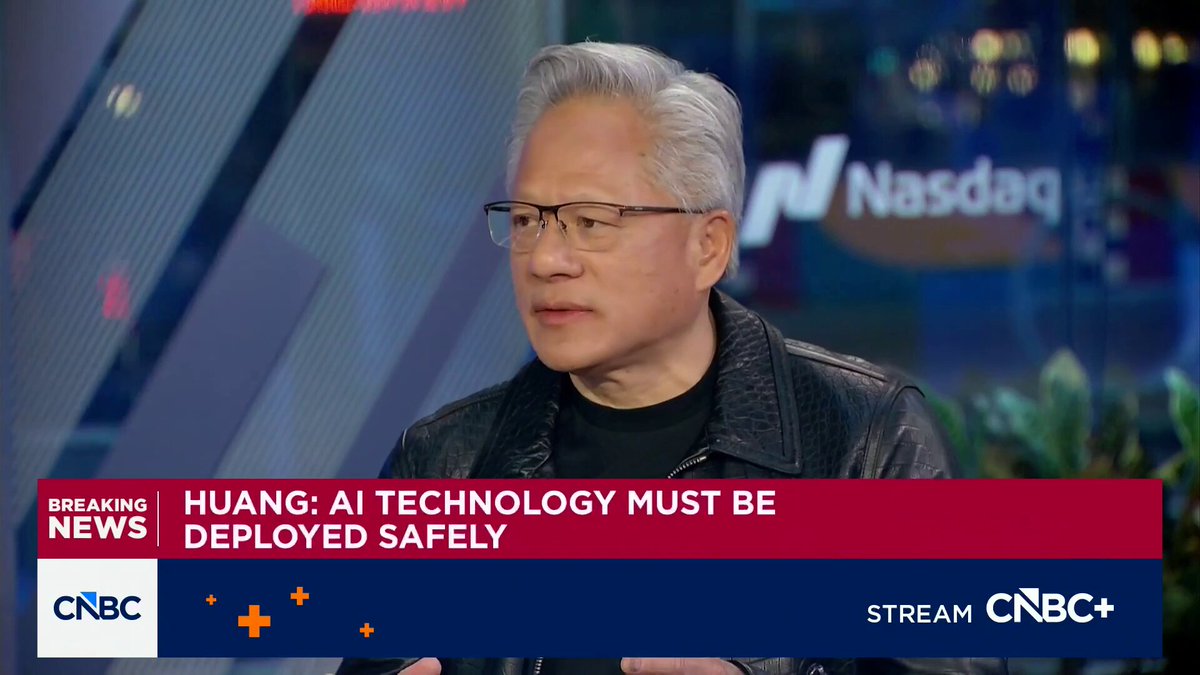
Huang says Nvidia will push AI responsibly and safely
The CEO said AI innovation and safety are not in conflict, and that AI agents should start with no permissions by default.
Nvidia CEO Jensen Huang said the company will advance AI “responsibly and safely,” while adding that there is no conflict between AI innovation and safety. A separate report quoted him as saying AI agents should have no permissions by default, with access granted only when needed.
The remarks center on how AI agents should be permissioned rather than on a new product launch or financial disclosure. In the current stream of posts, multiple market wires are converging on the same message: Nvidia is emphasizing safety as AI deployment expands.
For markets, the comments feed directly into the NVDA narrative because Nvidia sits at the center of the AI infrastructure trade. Recent coverage in the site’s news library also shows investors still weighing AI enthusiasm, slowdown risk, and broader AI-related deal activity.
There is no additional company clarification in the provided material, and no denial is reported. What can be verified here is limited to Huang’s public push for a default-deny approach to AI agent access.
Anthropic says 47% of 2025 sales ran through Amazon and Google
Reuters’ review of the company’s confidential IPO filing shows rising dependence on cloud marketplaces and a revenue mix dominated by usage-based billing.
Reuters, citing Anthropic’s confidential IPO prospectus, reported that 47% of the company’s 2025 sales flowed through Amazon and Alphabet’s Google cloud marketplaces, equal to about $2.16 billion. The filing also showed revenue of nearly $4.6 billion in 2025 and operating losses above $8 billion.
The prospectus gives a clearer picture of Anthropic’s business model. About $3.8 billion of revenue came from usage-based Claude billing, while subscription revenue was $789 million, leaving subscriptions below 20% of sales.
For Amazon and Alphabet, the filing underscores how central Anthropic has become to cloud distribution and AI infrastructure economics. Reuters said the company paid roughly $351 million in distribution fees to the platforms in 2025, or about 16 cents for every dollar of marketplace sales.
Anthropic said selling Claude through Amazon, Google and Microsoft helps it reach existing customers and expand market penetration. It also warned that reliance on a limited number of partners and suppliers could create conflicts of interest and affect access to compute. Amazon and Alphabet declined to comment, Reuters reported.
Reuters reported that McDonald’s is increasingly using artificial intelligence to guide menu pricing across the U.S. and some global markets. The system estimates how much customers at each restaurant are willing to pay and recommends menu prices.
That means the same item can be priced differently even at nearby locations. Reuters said the effort is designed to lift headquarters’ profit, but it could also alienate customers and attract antitrust scrutiny.
A separate follow-up in the site’s news library said franchisees described wider gaps between prices on identical items at restaurants within the same neighborhoods. The pricing push is now a key part of the MCD story.
No denial from McDonald’s was included in the materials provided. The debate centers on how far AI should be used in restaurant pricing decisions.
TSMC evaluates a Texas expansion as U.S. chip buildout keeps growing
The latest X signal says the plan is still not finalized, but it adds to TSMC’s ongoing U.S. manufacturing push and could support more equipment demand.
X posts from multiple outlets say TSMC is evaluating a potential investment in Texas to expand U.S. chip production. The plans have not been finalized, and the reports frame the move as an addition to the $265 billion TSMC has already committed to Arizona.
The news lands alongside recent coverage in the site’s library pointing to a second U.S. site being eyed for a chip-making hub. That makes the Texas review part of a broader, still-developing U.S. expansion story rather than a one-off headline.
For the market, the main read-through is TSM and the semiconductor equipment supply chain. More fabs typically imply more tool demand and a longer capital-spending runway, which is why investors watch each incremental site update closely.
At this stage, the available materials stop short of a final decision, dollar amount, or project timeline. The reports repeatedly stress that the Texas plan remains under evaluation, not announced as a done deal.
CoreWeave said on Sept. 30 that NVIDIA Vera Rubin NVL72 is now available on its cloud and that Cognition is the first customer to run production workloads on the system. CoreWeave said Cognition is using the platform for training, reinforcement learning and production inference for Devin, its AI coding agent.
The announcement turns Rubin from a roadmap item into a live deployment at customer scale. CoreWeave said Cognition’s independent benchmarks on CoreWeave Cloud showed a 4.8x increase in total token throughput for SWE-2 inference versus a GB200 NVL72 baseline, and a 3.8x boost in output token throughput for reinforcement learning.
For investors, the update reinforces the commercialization story for both CRWV and NVDA. CoreWeave is positioning itself as a fast path for bleeding-edge NVIDIA systems, while NVIDIA gains another public example of Rubin being used in production rather than only in demos or lab tests.
CoreWeave also said Ennoble Care selected its cloud for clinical AI inference using RTX Pro 6000 Blackwell nodes, suggesting its customer base is broadening beyond general-purpose AI. Both CoreWeave and Cognition said the system is already being used in real workloads, with CoreWeave framing the launch as production-ready capacity for select customers.
Nebius has signed a 12-year agreement for 50 MW of dedicated AI data center capacity with AIB Data Centers, with the deal backed by a 65 MW power arrangement. AIB says the contract covers critical IT capacity at its southeastern U.S. data center.
The key constraint, Nebius says, is time to power. The company also said customer prepayments help finance the build while limiting dilution.
For the market, the update puts NBIS and AIB in focus: Nebius as the demand-side beneficiary of secured capacity, and AIB as the provider turning power access into long-term contracted AI infrastructure revenue. Recent coverage in the news library has also highlighted Nebius’s rising demand, price increases on GPU clusters, and expensive valuation.
AIB said the transaction validates its strategy of securing power first and converting it into contracted revenue. No denial from either side appears in the supplied materials.
Disney is laying off several hundred employees, with the cuts concentrated in human resources and technology. Multiple reports put the latest reduction at around 300 jobs.
It marks the company’s third round of layoffs this year. Disney already eliminated about 1,000 positions in April and several hundred more in July across areas including Pixar and ESPN.
For investors, the news speaks to the pace of Disney’s restructuring rather than a change in a single business line. The layoffs appear aimed at internal functions, suggesting ongoing cost and organizational adjustments at DIS.
The reporting is based on accounts from people familiar with the matter and follow-up coverage from multiple outlets, rather than a full company statement in the materials provided.
How this story unfolded
2026-08-126 posts · 6 authors
Reports emerged that former Disney CEO Bob Iger and Josh Kushner agreed to buy the LA Lakers for a record $12-12.5 billion.
2026-08-135 posts · 3 authors
Company
Aterio flags delay risk for Oracle’s 1.3 GW Wisconsin data center
The new analysis says grid interconnection approval is still pending, putting Oracle’s H2 2027 delivery target at risk.
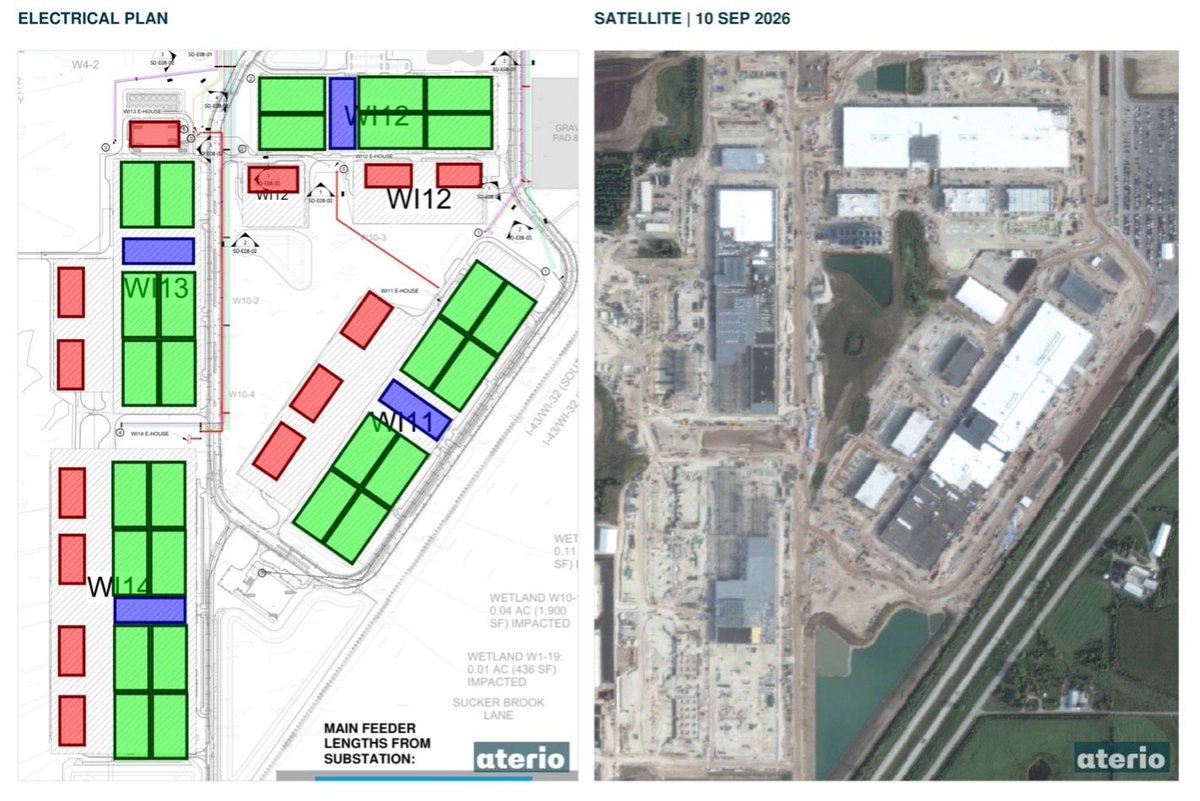
Aterio said Oracle’s 1.3 GW Port Washington data center in Wisconsin faces a material risk of missing its H2 2027 delivery target because the required grid interconnection is still awaiting regulatory approval. The firm’s base case calls for partial power in December 2027 and full 1.3 GW capacity in October 2028.
The X signal matches a same-day Business Wire report in our news library, indicating this is a fresh analytical update on the same Project Lighthouse story. The new post adds a sharper market read on timing, rather than introducing a separate event.
For Oracle, the issue matters because the project is tied to its AI infrastructure buildout and expectations around when meaningful load can come online. The X post also noted ORCL was down about 0.9% pre-market, reflecting an immediate market reaction in the stock.
No Oracle response is included in the material provided. Based on the available reports, the dispute centers on interconnection approval and delivery timing, not on whether the project remains underway.
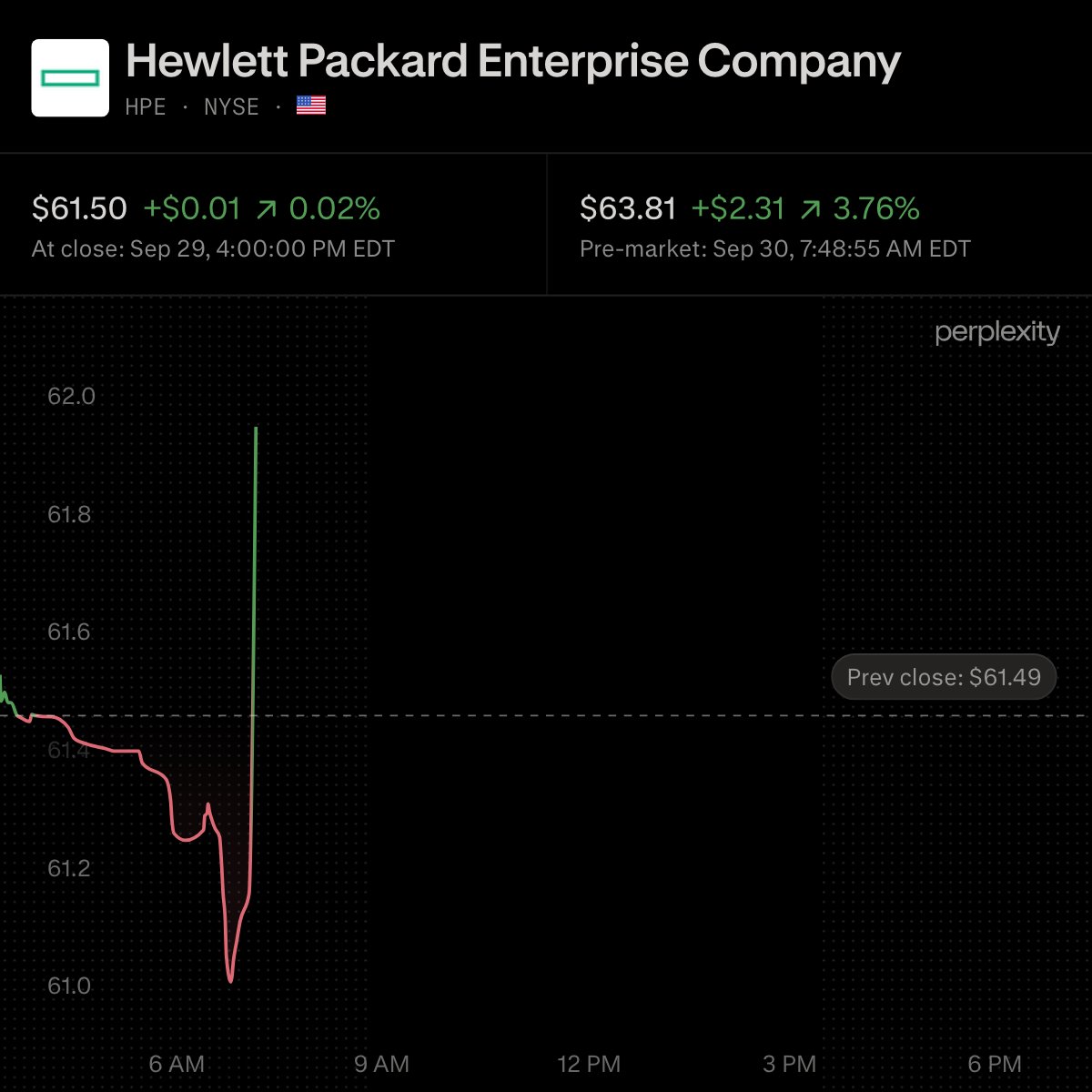
Hewlett Packard Enterprise said it has secured a $1.2 billion order from cloud provider Vultr for AMD Helios AI Rack systems. Multiple X posts describe it as HPE’s first order for the new platform.
In the same update, HPE raised its FY27 networking revenue growth guide to the high-teens to low-20s range. That points to a stronger long-term view for the company’s networking business.
The news puts HPE and AMD in focus, while also highlighting Vultr’s need to keep expanding AI capacity. One signal cited Vultr as saying AI demand continues to outpace available capacity.
This is a specific commercial win tied to full-rack AI systems rather than a broad industry theme. X signals also pointed to premarket gains in HPE, but no additional company detail was included in the source set.
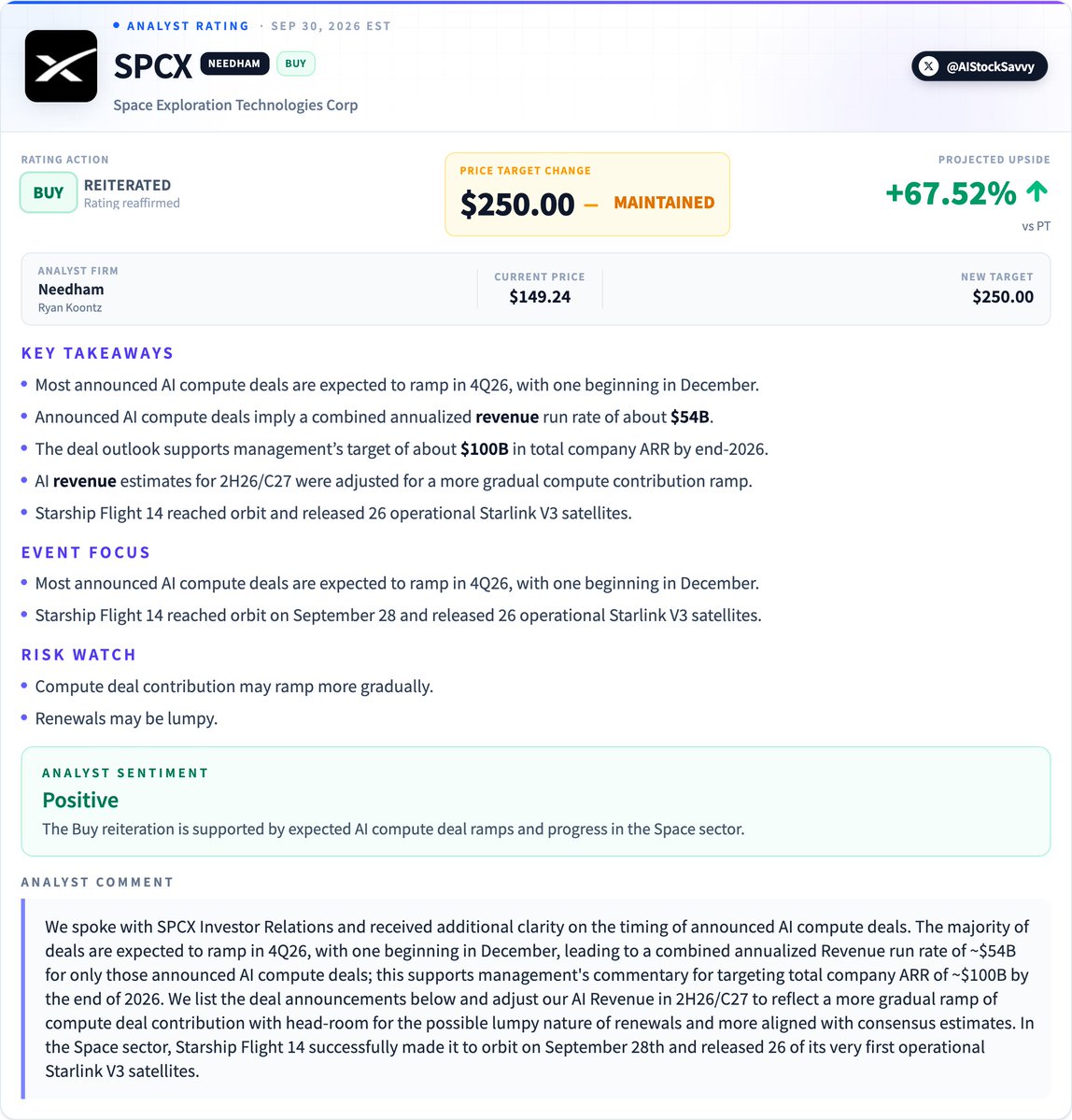
Needham reiterated a Buy rating on SpaceX and kept its $250 price target. The firm said announced compute deals are expected to reach a combined $54 billion annualized revenue run rate.
TD Cowen also initiated coverage of SpaceX with a Buy rating and a $200 price target. It said AI compute leasing could become the company’s biggest near-term revenue driver alongside Starlink.
The fresh calls shift attention toward SpaceX’s AI compute business as a meaningful new catalyst for SPCX. Investors are weighing how far that segment can support the company’s broader revenue ambitions.
Needham added that the announced compute deals could help support management’s goal of roughly $100 billion in total company ARR by the end of 2026. TD Cowen framed compute leasing as a potential inflection point for the company’s revenue mix.
Multiple finance accounts on X are circulating a new comment attributed to Elon Musk: SpaceX and Tesla are targeting 200 GW of annual solar production. The post stream points to a combined push in solar manufacturing and deployment, rather than a standalone product announcement.
The idea has been in the market for months. In January, pv magazine USA reported Musk saying the SpaceX and Tesla teams were each working toward 100 GW a year of solar manufacturing in the U.S., and a later follow-up said that scale would be far above then-existing U.S. capacity.
For investors, the immediate read-through is to SPCX and TSLA as “AI power” names tied to solar manufacturing, storage, and data-center electricity supply. That said, today’s signal is still a reposted statement and not a fresh company filing or a detailed rollout plan.
The verifiable backdrop comes from pv magazine USA’s January and May coverage of Musk’s solar comments and the associated U.S. capacity context. Because today’s incremental development is another public remark on the same theme, the event line is better treated as a renewed signal than a brand-new project launch.
How this story unfolded
2026-08-015 posts · 5 authors
Kalshi put a 60% probability on a Tesla-SpaceX merger before 2028, while NASDAQ 100 performance and 52-week lows were highlighted.
Company
Altman says Meta’s Muse is a nice product, not a threat
OpenAI’s chief executive offered a positive read on Meta’s Muse, softening the day’s competitive chatter around the product.
OpenAI CEO Sam Altman said Meta’s Muse is a “nice product” and added that he does not feel threatened by Meta. Multiple X posts carried the same line today, making the statement the key new development in the story.
A related Business Insider item published in the past 48 hours also focused on Muse’s branding and mascot angle, showing the product is getting broader attention in media coverage. The available material, however, does not show any new operational update from Meta or OpenAI beyond Altman’s comments.
For markets, the main ticker in focus is Meta Platforms ($META). The remarks amount to a public product assessment rather than evidence of a meaningful business shock, and the sourced material does not include any fresh financial disclosure tied to either company.
Overall, the day’s signal centers on perception: Muse is being discussed as a product with some appeal, while Altman explicitly downplayed competitive pressure. No additional response from either side appears in the sourced material.
Japan’s Ministry of Land, Infrastructure, Transport and Tourism said August new housing starts totaled 63,974 units, up 6.1% from a year earlier, below the 7% forecast. The seasonally adjusted annualized pace came in at 753,000 units, down 2.7% from the prior month.
The report suggests housing activity remained in expansion for a fifth straight month, but the pace moderated from July’s 8.2% gain. Local reporting also pointed to a base effect after stricter energy-efficiency standards for new homes took effect last year.
For markets, the release is mainly relevant for construction, building materials and housing-related shares, while its direct impact on Bank of Japan policy expectations is usually limited. The broader read is that monthly housing data can be noisy, so investors tend to look for confirmation from subsequent construction and orders data.
No additional official comment from the ministry was included in the reports reviewed. Traders will likely watch the next two monthly prints for confirmation of whether the slower pace was a one-off or part of a broader trend.
China’s September RatingDog manufacturing PMI rose to 52.1 from 51.5 in August, while the services PMI edged up to 51.6 from 51.4, according to reports published on Wednesday. Both readings came in above forecasts and remained above the 50 threshold that separates expansion from contraction.fxstreet.com
The data matter because they were released on the last trading day before mainland China’s week-long holiday closure, when offshore assets often trade on stale positioning. The official September manufacturing PMI also returned to 50.1, while the official non-manufacturing gauge improved to 50.2, giving both private and official surveys a firmer tone.udn.com
For markets, the mix points traders toward industrial demand, input costs and margin pressure. The report said manufacturing input prices accelerated to a four-month high on metals and oil, while services selling prices fell at the fastest pace in years, a combination that can matter for commodity producers and China-sensitive equities.fazen.markets
The UK’s current account deficit narrowed to £19.9 billion in the second quarter of 2026, or 2.5% of GDP, according to the Office for National Statistics. That was better than the roughly £25.5 billion forecast circulated on market wires and narrower than the revised £21.1 billion in the prior quarter.
The improvement was driven mainly by a smaller trade deficit: the goods deficit narrowed to £55.5 billion and the services surplus widened to £51.3 billion. Offsetting that, the primary income deficit widened to £3.8 billion, while the underlying deficit excluding precious metals came in at £11.3 billion versus £14.3 billion previously.
The release matters for sterling and UK rates because it speaks to the country’s external financing position. A smaller deficit generally implies less need to attract foreign capital, though the market reaction usually depends on whether the surprise is large enough to alter the broader macro narrative.
ONS also reported a £29.7 billion net financial inflow in Q2 and a slightly wider net international investment liability position of £196.8 billion. The series remains subject to revisions, and ONS noted that historical current account data can be materially restated.
JPMorgan CEO Jamie Dimon is calling for a “big, beautiful” U.S.-Europe free-trade pact, with the framework potentially expanding to other democratic allies. In the signal material, he says such a bloc could help set global trade rules and bolster the West against China.
The remarks are part of Dimon’s broader pitch for a reset in Western economic and security policy. A Wall Street Journal opinion item quoted in the signal says renewed U.S. values and alliances, combined with bold reforms in Europe, would secure Western strength for the next 250 years.
For markets, the direct equity reference is JPM because the comments came from its chief executive. The issue is geopolitical rather than company-specific, but it may still be read as a macro signal for cross-border finance and risk appetite. Recent local coverage on JPMorgan, however, has centered on company management changes rather than this trade proposal.
Standard Chartered initiated coverage of Ethena on Sept. 30 and set a $2 target for ENA by the end of 2028. The call, reported by multiple crypto outlets, rests on the view that USDe growth will translate into protocol revenue and token buybacks, giving ENA a clearer value accrual path.
The note reframes Ethena less as a speculative token and more as a cash-flow-linked governance asset. That matters because Ethena has recently expanded its product surface: the protocol updated buyback-related governance in August and, in September, broadened USDe distribution and backing options across Tron and Binance-linked strategies.
For the market, ENA is the direct beneficiary of the new valuation lens, while USDe is the operating engine behind it. The key mechanical detail is that the buyback program begins only after USDe supply reaches $7.5 billion, so the near-term story is less about a single-day move and more about whether Ethena can keep scaling supply and protocol revenue.
Standard Chartered’s broader thesis places Ethena inside a wider stablecoin and tokenization cycle. Ethena’s own materials say USDe launched in February 2024 and has since processed more than $30 billion through mint and redeem flows, underscoring the protocol’s scale as the bank argues for more upside in ENA.
Citigroup downgraded Moderna to Sell from Hold, arguing that the company’s recent rally is no longer supported by revenue and profit forecasts. In premarket trading, Moderna fell about 6%, according to the reports cited in the signal and the newsroom feed.
The move lands after a powerful run in the stock: the company’s shares had climbed more than 600% and recently hit a fresh 52-week high. That surge has been closely tied to enthusiasm around Moderna’s oncology push.
For markets, the immediate focus is MRNA, with the downgrade driving the price reaction. Related coverage also noted that Merck and Pfizer were flat, underscoring that the pressure was specific to Moderna’s valuation rather than the broader biotech group.
No response from Moderna was included in the materials reviewed.
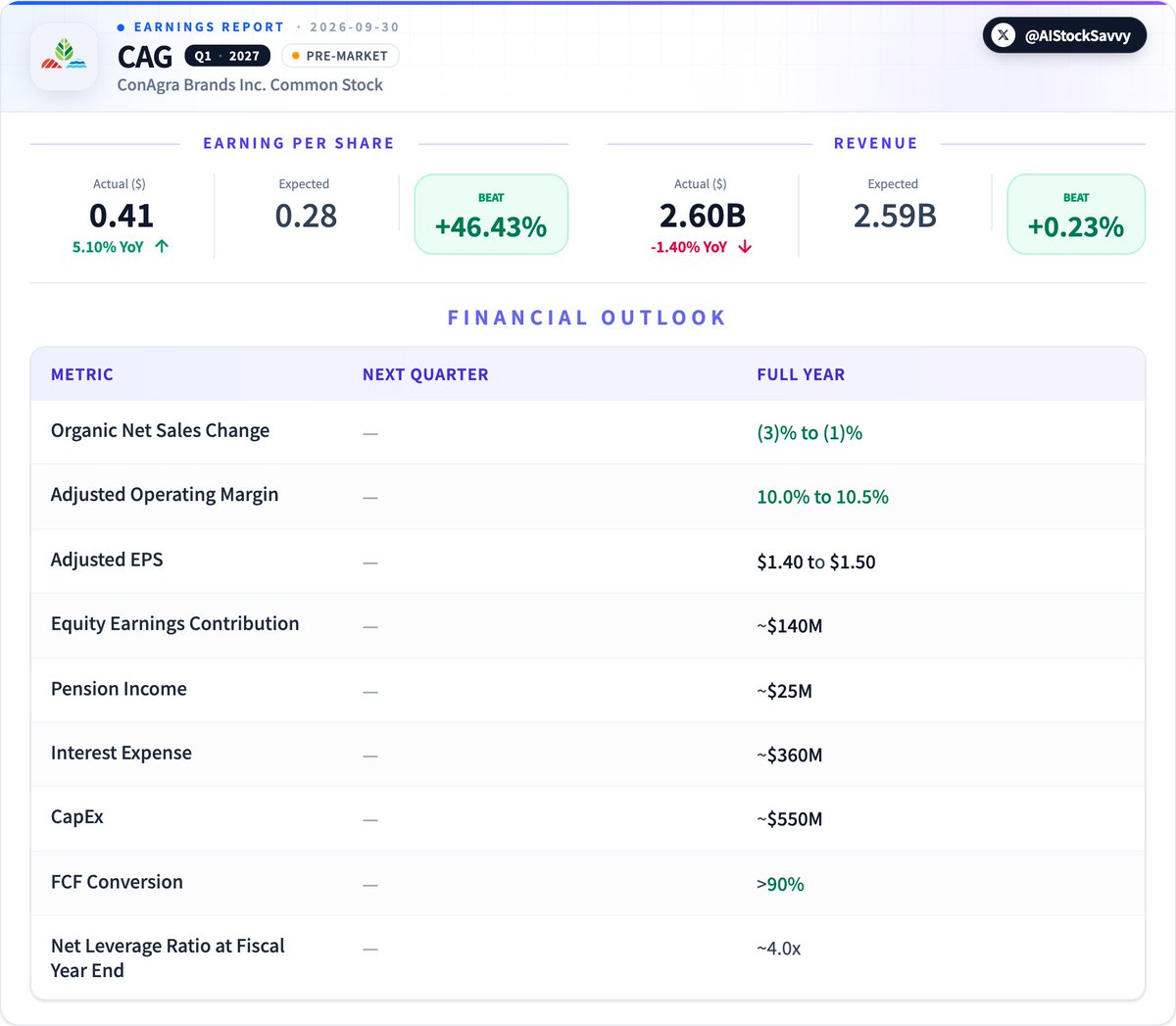
Conagra Brands reported first-quarter fiscal 2027 adjusted earnings per share of 41 cents, above the 29-cent estimate in the X signal. Adjusted operating margin came in at 11.5%, and sales reached $2.6 billion, also slightly ahead of expectations.
The quarter covered the period ended Aug. 30, 2026, according to the company report referenced in the news library. Reuters said the results beat Wall Street estimates for both profit and sales.
For the full year, Conagra still sees adjusted operating margin at 10% to 10.5% and organic net sales down 1% to 3%. The update keeps CAG in focus for investors tracking margin durability in packaged foods.
The figures in this story are drawn from the company’s latest earnings release and corroborated by the reporting in the news library. No denial by the company is reflected in the source material.
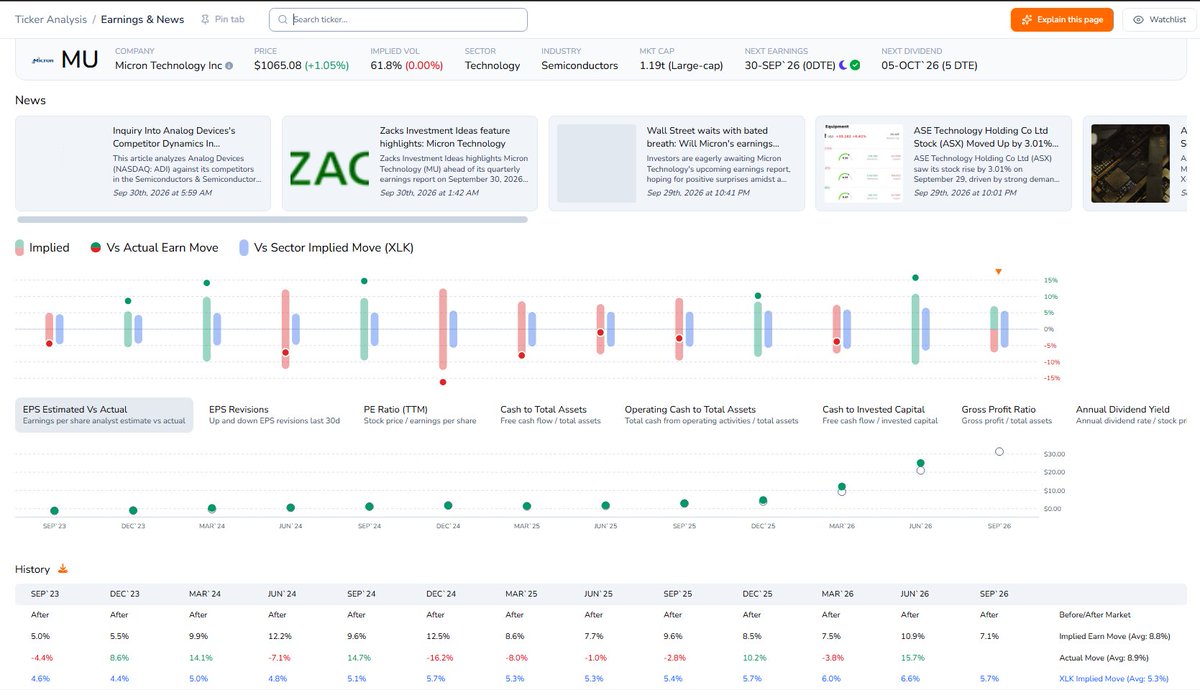
Micron Technology (MU) is due to report earnings after the bell tonight. Several X posts put the stock’s implied post-earnings move in a wide range, from roughly 7.1% to 10%, with the most common estimate clustering around 8%.
The same setup appears in the news flow from the past 48 hours: Investopedia says Micron is set to report after markets close today, while a YouTube segment noted options are pricing in about a 10% move. The market is clearly bracing for a meaningful reaction.
The debate is less about direction than about whether Micron can clear a very high bar. One X post cited 29 of 30 analysts as Strong Buy and said a beat-and-maintain could still be met with selling pressure, but that view is commentary rather than confirmed fact.
For traders, the key variable is the company’s earnings and guidance relative to expectations, and whether the options market’s elevated pricing collapses after the release. That setup can create sharp short-term moves even if the underlying result is broadly positive.
ANZ’s September business outlook survey showed New Zealand business confidence slipping to 51.9 from 53.7 in August. Firms’ own-activity outlook edged down to 47.9 from 48.2, while reported past activity fell to 10.8 from 16.4.
ANZ said most responses were collected early in the month, but about a quarter arrived after a reminder later in September, when Dubai spot oil had climbed from roughly US$100 a barrel at the start of the month to a peak of US$128. The bank said activity indicators weakened as oil rose, but inflation measures were little changed.
The survey matters because it is one of New Zealand’s key high-frequency leading indicators and is watched closely for signals on growth, hiring, investment and pricing. ANZ’s read-through was that the recovery remains uneven, but the late-month oil shock did not materially lift inflation expectations.
For markets, the release is more relevant for near-term rate expectations, local bonds and the New Zealand dollar than for any single stock. ANZ highlighted stable inflation readings, including one-year inflation expectations at 3.25% and three-month price expectations at 1.76%.
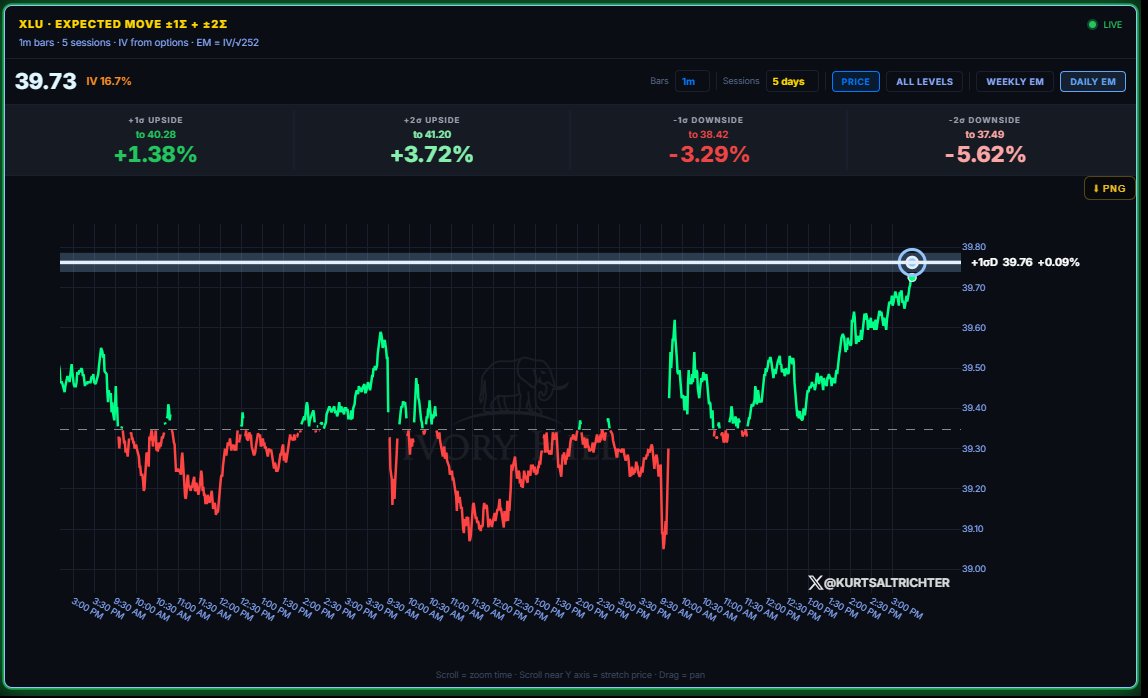
On Sept. 29, XLU printed a bullish engulfing candlestick on heavier volume, and traders on X quickly highlighted the move as a possible short-term reversal signal. Several posts also pointed to rising call activity, suggesting the setup is drawing fresh attention from options traders.
The backdrop is still dominated by higher long-end yields. ETF.net reported that the 30-year Treasury yield touched 5.62% on Sept. 29, its highest level since 2002, while StockCharts noted that XLU had already been deeply oversold after a sizable drop from its February peak.
For markets, XLU matters because utilities are one of the most rate-sensitive corners of the S&P 500. A stabilizing move in the sector can also influence sentiment in other yield-sensitive groups such as real estate, though the current evidence is still technical rather than fundamental.
CNBC Pro, citing Fairlead Strategies, said utilities had become short-term oversold and could be due for a relief rally. StockCharts added that the ETF was approaching support, reinforcing the view that this is a tradeable bounce setup rather than a confirmed trend change.
Spain's largest bank Santander disclosed 129,615 shares of BlackRock's spot Bitcoin ETF, while South Korea's KOSPI volatility exceeded Bitcoin's.
2026-08-2532 posts · 27 authors
Thailand's SEC proposed regulations for Bitcoin and crypto ETFs with public comments open until Sept 20, while U.S. Bitcoin ETF volume surged to $5B, 72% above average.
2026-08-2640 posts · 28 authors
Thailand's SEC advanced spot Bitcoin and Ethereum ETF rules; U.S. spot Bitcoin ETFs saw $2.08B inflows in five sessions; BlackRock enabled direct BTC-to-IBIT swaps with a $1M minimum.
2026-09-2330 posts · 26 authors
U.S. spot Bitcoin ETFs saw $999M in daily inflows, the largest since Oct 2025, turning YTD flows positive after a $4.6B surge over the past month.
2026-09-2922 posts · 14 authors
Bitcoin rose 24% since the Iran war, beating tech and S&P; U.S. spot Bitcoin ETFs saw 8 consecutive days of inflows; HANetf launched the first euro-hedged Bitcoin ETC.
2026-09-3010 posts · 8 authors
Bitcoin gained 43.1% in Q3, its best quarter since Q4 2024; options traders targeted $90K+; the first euro-hedged Bitcoin ETP went live on Euronext Paris and Xetra.