US equity futures erased all of their losses and turned positive after midterm election results came in, with the Dow Jones Industrial Average opening nearly 1,000 points higher and the Nasdaq 100 up more than 1%. Earlier in the session, S&P 500 perpetual futures fell below 7,500 and Nasdaq futures dropped more than 2%, while Japan's Nikkei and South Korea's KOSPI also slid.
According to the X account kobeissiletter, markets fell and then reversed sharply after Democrats took control of the House and Senate; the account described the prior night's decline as a "textbook bear trap" and said US stocks added more than $1 trillion in market cap at the open. The same account said gold and silver added a combined $1 trillion in market cap on the day. These market-cap and index-level figures come from a single social media source and have not been independently verified.
On the sector side, high-beta AI semiconductor names rallied after earnings, with one account citing AEHR and FN. Coverage in the past 48 hours focused on Cipher Digital (CIFR): the company reported weaker-than-expected third-quarter sales, analysts cut price targets while keeping bullish ratings, and the stock fell 53.9% in October amid AI financing concerns and an $850 million convertible debt offering.
The causal link between election results and market direction comes from social media commentary rather than official data; futures levels and the gold and silver market-cap moves lack cross-verification from authoritative sources, and readers should rely on exchange and official settlement data.
Sources:
Earnings
AMD Q3 revenue tops $13.4B as data center sales hit $8.55B
AI demand drives beat; shares rise over 6% after hours, adding $50 billion in market cap
AMD reported third-quarter adjusted earnings of $2.09 per share, beating the $1.94 consensus, on revenue of $13.4 billion versus the $13.1 billion expected. Data center revenue came in at $8.55 billion, above the $8.13 billion estimate, while gross margin reached 56% against expectations of 45%.
The company guided fourth-quarter revenue to $17 billion, ahead of the $16 billion consensus, with gross margin guidance of 55%, in line with expectations. Data center revenue has grown from $1.1 billion in the same quarter of 2021, underscoring sustained AI compute demand.
AMD shares rose more than 6% in after-hours trading following the report, with some reports citing gains above 9%, adding roughly $50 billion in market capitalization. The stock was up about 4% at $486 ahead of the release.
Wall Street analysts began revising AMD price targets after the results. A separate 13F filing showed Aware Super Pty Ltd increased its AMD position by 2.5% in the third quarter.
Tesla falls 5.6%, SpaceX 5% as Democrats' midterm wins put Musk's companies in focus
Both stocks slid in after-hours and premarket trading as investors weighed tighter scrutiny of government contracts; Morgan Stanley's $300 SpaceX target failed to offset the selloff
Tesla (TSLA) and SpaceX (SPCX) shares fell in after-hours and premarket trading after early US midterm results pointed to a decisive Democratic win. Tesla dropped about 5.6% and SpaceX about 5%, with both down more than 5%.
Both companies are controlled by Elon Musk, a prominent Republican backer. Investors focused on the prospect of tighter scrutiny of SpaceX's government contracts and on Musk's political exposure once Democrats take Congress.
Morgan Stanley raised its SpaceX price target to $300 the same day, but the move did not offset election-driven selling. Forbes reported that Tesla, SpaceX and AI-linked stocks slid after Democrats took Congress.
Filings tracked in our newsroom show institutions had been adding exposure: Bank Julius Baer opened a new 37,327-share SpaceX position in the third quarter and raised its Tesla stake by 1.3%, while Aware Super lifted its Tesla stake by 6.7%.
Binance on Tuesday published its most detailed account yet of the Oct 29 breach that drained roughly $6.3 billion, saying hackers spent months grooming a wallet engineer through fake job interviews before getting malicious code onto his work machine via a rigged developer tool, and also compromised an internal AI system. Co-CEO Richard Teng confirmed the chain of events to CNBC.
On-chain analysis from TRM Labs and Chainalysis found the attackers moved funds across ten blockchains, most of it in about 20 minutes, at a speed and scale that ruled out human approval; preparation began at least 36 hours before the attack. The FBI attributed the theft to TraderTraitor, the North Korean unit behind the $1.5 billion Bybit hack in 2025.
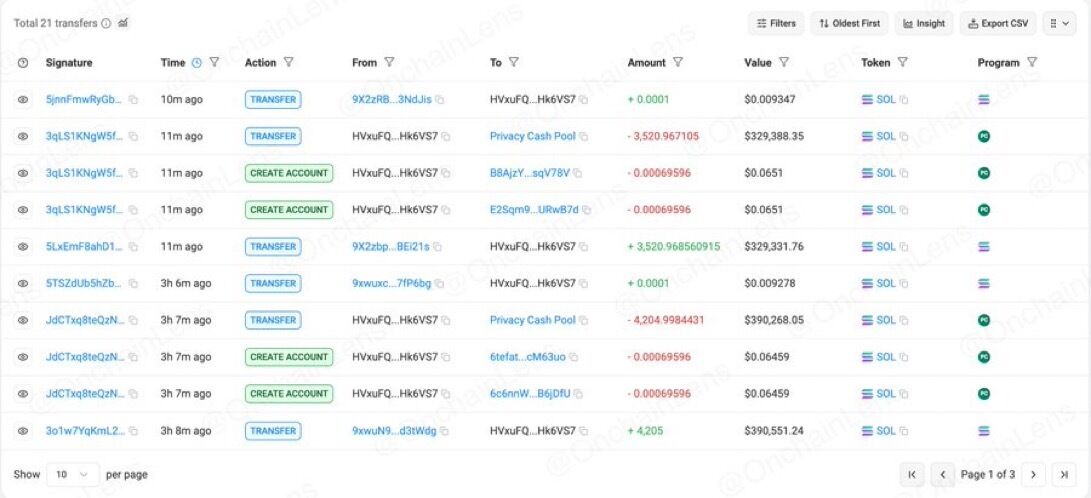
Binance says about $2.85 billion has been frozen or intercepted and that 98% of affected tokens have been replenished, with the remainder in less liquid assets. CZ told Yahoo Finance that "the users did not suffer any loss" and withdrawals have resumed. An address linked to the hackers deposited 8,567 SOL, worth about $798,000, into the Privacy Cash mixer.
North Korea denied involvement. Kim Yo Jong called the FBI's attribution "a trite provocation," while Trump said "we don't know if it's North Korea." With roughly $2.4 billion held in native ETH and BTC that no issuer can freeze, recovery depends on how quickly exchanges and law enforcement act.
How this story unfolded
2026-10-30
Earnings
Datadog Q3 revenue tops $1.2bn but Q4 guide assumes only minimum commitment from largest customer; shares fall 17% premarket
A beat on revenue and EPS was overshadowed by a conservative fourth-quarter guide and customer-concentration questions
Datadog reported third-quarter 2026 revenue of $1.197bn, up 35% year over year and above the roughly $1.15bn consensus, with non-GAAP diluted EPS of $0.81 versus $0.64-0.65 expected. Non-GAAP operating income was $334m at a 28% margin and free cash flow was $251m; customers with ARR of at least $100,000 reached about 4,860, up roughly 20%.
For the fourth quarter the company guided to revenue of $1.19bn-$1.20bn, implying 25%-26% growth, and non-GAAP EPS of $0.69-$0.71; full-year revenue is guided to $4.515bn-$4.525bn. Management said its largest customer renewed above minimum commitments in the third quarter, but the fourth-quarter outlook models only the contractual minimum, alongside seasonal slowing in late December and marketing spend including AWS re:Invent.
Shares fell as much as 12%-17% in premarket trading from a prior close of $220.52, despite the beat. Investors focused on the deceleration implied by guidance and quarterly variability tied to the largest customer rather than the size of the third-quarter outperformance.
Duolingo also reported the same day, with revenue of $309m, up 14%, EPS of $0.54 below estimates and daily active users of 64.9m, up 29%; Arista Networks, Booking and Astera Labs also beat. Datadog's drop contrasted with gains elsewhere in the group, underlining how sensitive richly valued software names are to forward guidance. Datadog did not reconcile its non-GAAP guidance to GAAP measures.
CVS confirms split into two public companies by first half of 2028, separating about 9,000 pharmacies
The breakup reverses a strategy built on the roughly $78 billion Aetna acquisition, leaving the largest U.S. drugstore chain and its insurance and PBM arms as separate listings
CVS Health said Wednesday it plans to split into two separate public companies by the first half of 2028. One would hold roughly 9,000 retail pharmacies; the other would hold the Aetna insurance business and Caremark, one of the three biggest pharmacy benefit managers in the U.S. The company confirmed the entity keeping the CVS Health name will be led by CEO David Joyner.
The move marks a significant reversal of CVS' strategy of building an integrated healthcare business through acquisitions, including its roughly $78 billion purchase of Aetna, according to the New York Post. The FT described the breakup of the roughly $117 billion healthcare empire as one of the largest corporate splits of all time.
Bloomberg first reported that CVS was discussing a spin-off of its retail pharmacy business, and the stock jumped on the report. After the split, the drugstore arm and the insurance and PBM businesses will face different regulatory and profitability dynamics, requiring investors to value the two assets separately.
CVS also reported third-quarter earnings of $2.09 per share, beating the Zacks Consensus Estimate of $1.62 and compared with $1.6 a year earlier. The materials did not disclose further financial details of the split.
Oracle Scraps $7 Billion AI Chip Lease Deal With Tencent
The five-year pact would have given Tencent up to 100,000 advanced AI chips via Oracle data centers in Southeast Asia; the reported cancellation tightens compliance lines for cross-border compute leasing
Oracle has canceled a five-year, $7 billion AI chip leasing agreement with Tencent, according to the Financial Times, which said the deal would have given the Chinese company access to as many as 100,000 advanced AI chips through Oracle data centers in Southeast Asia. Reuters relayed the report, and several market wire accounts followed.
The report attributed the cancellation to pressure from the Trump administration. Neither Oracle nor Tencent had publicly commented as of publication, and the deal terms rest on a single source, the FT.
Oracle shares fell about 4% in premarket trading. The reversal comes as the company funds an aggressive AI infrastructure buildout while promising investors a cap on new borrowing through 2030, putting a focus on the durability of its overseas compute contracts.
The report lands against a tightening policy backdrop: the US Treasury's October 22 proposed rules to implement the COINS Act would turn many AI-related outbound investments from notifiable into prohibited, with comments due December 7.
Meta Platforms raised $15 billion in a five-part dollar bond sale on Tuesday after attracting as much as $58 billion in investor orders, roughly 3.9 times the amount sold. The longest tranche, maturing in 2056, priced at 2.2 percentage points over Treasuries after guidance tightened by 0.3 points.
The sale followed S&P Global Ratings' revision of Meta's outlook to negative from stable last week, citing uncertainty over its capital spending and negative free cash flow. Meta said last month that full-year capex would reach $135 billion to $145 billion, and reported negative free cash flow of $2.12 billion for the latest quarter.
Investors were paid more than in April: the 2056 tranche's spread is about 0.9 percentage points wider than a comparable bond Meta sold then, and its 10-year notes yield 6.55%, roughly a point above the average for AA-rated peers. Big Tech bond spreads over other investment-grade debt are the widest since 2003.
Meta also began marketing its first euro-denominated bonds in six parts, drawing about €53 billion ($59.52 billion) in orders for up to €9 billion of debt, according to Bloomberg. Citigroup and Morgan Stanley are managing the euro sale. Meta declined to comment.
President Donald Trump said in a Fox News phone interview on Nov. 3 that the United States would stop providing roughly $4 billion a year in aid to Israel by the end of the year, saying the country "doesn't need it," while weapons sales would continue. He described the move as an arrangement reached with Prime Minister Benjamin Netanyahu months ago but gave no details on how the funding would be terminated.
The current 10-year US-Israel security assistance memorandum, signed under the Obama administration in 2016 and effective from 2019, provides about $3.8 billion annually and runs through 2028. The $4 billion figure cited by Trump differs from the memorandum's annual level by roughly $200 million, and several outlets reported both numbers.
The announcement came as Americans voted in midterm elections. Trump framed it partly as removing a "bad talking point" used by left-wing Democrats against Republicans over Israel aid, naming Michigan Senate candidate Abdul El-Sayed. Israeli opposition leader Gadi Eisenkot said the remarks showed Netanyahu "can no longer be trusted and must be replaced."
For markets, the shift matters for US defense contractors' Israel-related sales: aid converted into Israeli self-purchases moves procurement decisions and payment from Washington to Israel's defense establishment, potentially altering order timing, though Trump said arms sales continue. No specific tickers were named in the reports.
US support for Israel has long been the largest of any country. Israel has received the inflation-adjusted equivalent of more than $300 billion in US economic and military support since 1948, according to the Council on Foreign Relations. A June Quinnipiac poll found 48% of voters, and 66% of Democrats, think the US is too supportive of Israel.
Circle Internet Group reported third-quarter 2026 total revenue and reserve income of $864.9 million, beating estimates of $776.7 million and rising 17% year over year. Earnings per share came in at $0.84 versus $0.64 a year earlier, and adjusted EBITDA reached $317 million, up 85%. Net income was $226 million, up 5% year over year.
Alongside the results, the company cut roughly 5% of its workforce in the quarter at a cost of $9.1 million, mostly employee payouts. USDC onchain transaction volume rose 49% to $13.9 trillion, and USDC minted reached $104 billion, above the $82.45 billion estimate.
Reserve income, the core of Circle's model, fell 8% year over year to $658 million, with a reserve return rate of 3.5% against a 3.52% estimate. Average USDC in circulation was $73.3 billion, up 8% but below the $74.08 billion expected. Circle reaffirmed its full-year outlook, including adjusted operating expenses of $570 million to $585 million.
Shares slipped 2% in premarket trading after the release, with investors weighing falling reserve yields against the cost cuts.
Palantir reported quarterly revenue above $2 billion for the first time, extending its streak of accelerating revenue growth to a seventh consecutive quarter. US commercial contract value grew 11% year over year, a slower pace than overall revenue.
Seeking Alpha's analysis (N2) cites 96% revenue growth and a 47% GAAP operating margin, while arguing that a 52x forward sales multiple leaves no margin of safety. Commentary relayed on X by Yahoo Finance made a similar point: the company beat expectations, but new business is growing more slowly.
Sell-side views diverged after the print. Barclays maintained Overweight and raised its price target to $273 from $265, while BofA Securities reiterated Buy with a $255 target, saying commercial acceleration validates the sovereign AI strategy. On Schwab Network, Laurens Founders called the stock a long-term buy.
Separately, Seeking Alpha flagged ETFs with heavy Palantir exposure after a selloff and noted analyst concerns over valuation and bookings. The company also announced a partnership with South Korean footwear manufacturer Changshin to deploy Foundry and AIP across development and factory operations.
Google said on Nov. 3 that starting early next year, Gemini, Gemini Notebook, Gemini in Classroom and Google Search will be entirely off for K-12 student accounts until school administrators explicitly turn each one on. According to The New York Times, schools that reject the AI features outright will also lose student access to Search. "Search and AI are deeply integrated," Chris Phillips, Google's vice president for education, told the Times.
The change walks back an August move that enabled some AI features by default in Classroom, which drew pushback from educators, parents and child-development researchers. Google framed the update as giving schools more control, and said Search will add step-by-step guided learning so students don't get quick answers to schoolwork.
The dispute is whether opting in per product amounts to a real choice. The Verge reported that administrators cannot keep Search while disabling AI Overviews or AI Mode, and Google's response on X did not directly address the claim that Search requires AI. Sen. Bernie Sanders called the policy "extortion," while New York Mayor Zohran Mamdani said Google was using monopoly power to force AI into public schools.
For Alphabet, the episode is a public fight over its education channel rather than a quantifiable revenue event; K-12 accounts and Chromebooks remain a key funnel for Google's ecosystem, and repeated policy shifts could complicate district renewals. The stock in question is Alphabet (GOOG).
How this story unfolded
2026-09-088 posts · 7 authors
Google Cloud and Accenture formed a 1,000-engineer unit to push Gemini's agentic AI into enterprise operations.
Earnings
Apple Q4 revenue tops estimates at $114.48B, but memory costs push gross margin guidance to 45%-46%
Strong iPhone and Siri AI demand offset by unprecedented memory cost inflation; investors focus on margin outlook as shares slip
Apple reported fiscal fourth-quarter revenue of $114.48 billion, above the $113.39 billion estimate, with earnings of $2.10 per share as revenue and profit both grew double digits and the active installed base hit another record.
Management guided December-quarter gross margin to 45%-46%, down from 48% in the third quarter, citing unprecedented memory cost inflation. Memory supply constraints are expected to persist into December and contribute to supply limits in the current quarter.
Shares fell as investors looked past the earnings beat toward the weaker margin forecast, with surging memory-chip prices and rising AI expenses weighing on sentiment. Commentary focused on whether services growth can support the case for buying the dip.
The pressure marks a reversal for Apple, which spent the past decade squeezing memory makers' margins as their dominant buyer before the AI data-center boom shifted bargaining power toward suppliers.
Separately, 13F filings showed several institutions adjusting Apple positions in the third quarter, including a 13.3% stake reduction by Crown Wealth Group and a new position by Greg Jennings LLC.
Uber reported third-quarter 2026 revenue of $14.77 billion before the market opened on Nov. 4, up about 10% year over year and above the roughly $14.69 billion analysts expected. GAAP diluted earnings per share came in at $0.25, down about 92% from $3.11 a year earlier, a comparison the company said was distorted by a $4.9 billion tax valuation release in the prior-year period. Net income was $512 million, including a $476 million pre-tax loss from revaluations of equity investments.
By segment, mobility revenue fell 2% to $7.52 billion, missing the roughly $7.71 billion consensus; delivery revenue rose 23% to $5.49 billion, just short of estimates; and freight revenue jumped 34% to $1.76 billion, well ahead of expectations and the main driver of the revenue beat. Gross bookings of $59.82 billion were roughly in line with the $59.83 billion consensus, and monthly active platform consumers reached 215 million.
CEO Dara Khosrowshahi said mobility performed slightly below expectations overseas, citing elevated fuel prices and tighter driver availability in several international markets, and said targeted investments were improving marketplace balance, with encouraging signs in October. Uber guided fourth-quarter gross bookings of $63.25 billion to $65.25 billion and non-GAAP EPS of $0.95 to $0.99, below the roughly $1.00 analyst estimate.
On autonomy, Uber said it expects about 700 fully driverless vehicles on its platform by year-end and more than 2,000 by the end of 2027, split evenly between the U.S. and international markets, adding Amazon's Zoox and Motional robotaxis in Las Vegas this quarter. The company also disclosed that President and Chief Corporate Affairs Officer Jill Hazelbaker will step down on Nov. 30; she was previously reported to be joining OpenAI.
EPS comparisons vary by source: some outlets compare non-GAAP EPS of $0.88 with a $0.86 estimate, others cite $0.90 or $0.96 as the consensus, while CNBC compared GAAP EPS of $0.25 with a $0.96 estimate. Any citation should specify the basis.
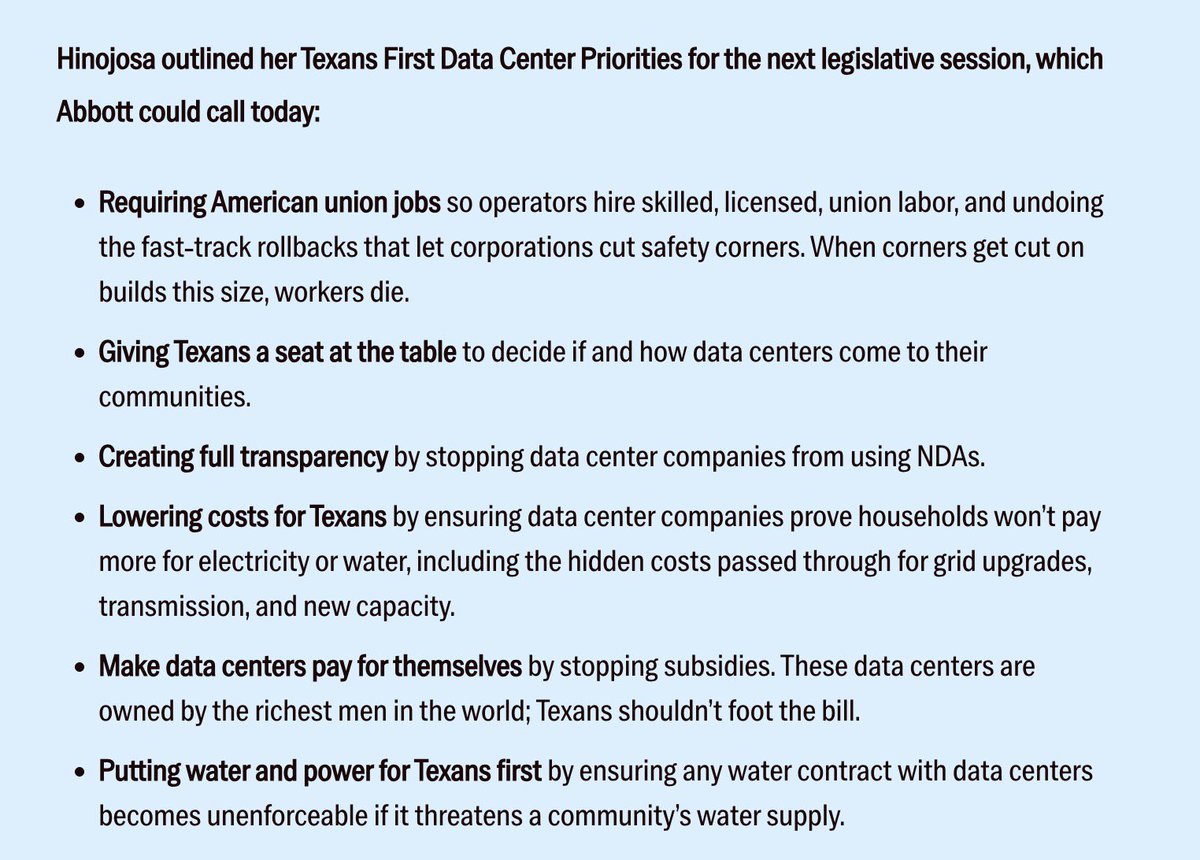
Democrats won sweeping midterm victories, including the Texas governorship, where Gina Hinojosa unseated Greg Abbott, and Georgia, where Keisha Lance Bottoms won the governor's race. Both candidates campaigned in part on pausing or restricting data-centre construction.
Data centres underpin the AI investment boom but have drawn growing local opposition over power and water consumption, light pollution and limited tax and job benefits. GLJ Research estimates Texas accounts for about a quarter of US data-centre capacity due to come online by 2030; Wells Fargo puts the state at 27% of planned gigawatts.
Core Scientific fell 2.8% and Iren 1.4% in premarket trading, while Applied Digital and CoreWeave were marginally lower; Asian chip names including TSMC, Samsung Electronics, SK Hynix and Kioxia also declined. Clean-energy shares rose. Goldman economists said federal AI and data-centre rules still need bipartisan support, but state and local Democratic wins could bring short-term moratoriums affecting about 45% of planned US capacity expansion.
Aidan Yao of the Amundi Investment Institute described the vote as more a referendum on AI than on Donald Trump. Vantage Point's Nick Ferres said return on investment and financing are both now more challenging, while some analysts said a slower buildout does not necessarily signal weaker AI demand and viewed the Nasdaq's roughly 8% drawdown over the past month as a buying opportunity.
Amgen reported third-quarter 2026 revenue of $10.37 billion, above the $10.07 billion consensus and up 8% year over year. Adjusted EPS came in at $6.45 versus $5.79 expected, up 14%, while non-GAAP operating income of $4.68 billion also beat the $4.33 billion estimate.
The company raised full-year revenue guidance to $38.9 billion-$39.7 billion from $38.2 billion-$39.4 billion, and lifted adjusted EPS guidance to $22.90-$23.70 from $22.30-$23.50. According to reports, this marks Amgen's third sales and profit guidance increase this year, driven by demand for cholesterol drug Repatha and newer medicines Imdelltra and Uplizna.
Despite the beat and raise, Reuters reported that Amgen shares dipped, suggesting investors parsed the guidance range differently. Amgen trades on Nasdaq under the ticker AMGN.
The company's full results release and earnings call transcript are available for further detail on product-level revenue and guidance assumptions.
US Officials Hold Up Approval for American Chip Equipment SK Hynix Needs to Expand China Output
Reuters, citing people familiar, says the approval is stalled; SK Hynix's China expansion depends on US-made tools, making the review pace a swing factor for memory supply expectations
US officials have held up approval for American chipmaking equipment that SK Hynix needs to expand production in China, according to people familiar with the matter, as reported by Reuters and relayed by multiple market news accounts on X.
SK Hynix operates memory production in China, and exports of US-made tools for such expansion typically require US authorization. The pace of that review bears directly on how quickly the company can carry out its China capacity plans.
The report lands as memory-chip shares swing on AI demand and valuation debate. According to our news library, Micron (MU) is trading near a three-month low even as analysts raise price targets, with a $35 billion buyback authorization set to unlock in weeks.
SK Hynix and US authorities did not publicly comment on the report as of publication; the approval status rests on the people familiar with the matter.
Google, a unit of Alphabet, said on Nov 4 it will invest $15 billion in Malaysia in 2027 and 2028, covering data centre campuses, clean energy, water security and workforce training. President and chief investment officer Ruth Porat announced the plan at an event at Universiti Malaya attended by Prime Minister Anwar Ibrahim.
The new campuses are planned for Eco Business Park in Puncak Alam and UMW High Value Manufacturing Park in Serendah, both in Selangor, plus Springhill Industrial Park in Port Dickson, Negeri Sembilan; its first campus at Elmina Business Park is already operational. Google separately committed $160 million to an off-river storage reservoir and a water treatment plant in Negeri Sembilan designed to produce 65 million litres of treated water a day, with Gamuda appointed to build the facilities.
Google said construction would contribute an annual average of $1.1 billion to Malaysia's GDP and support more than 37,000 local jobs a year, including about 6,000 in construction. Once operational, the facilities are projected to sustain more than 9,000 jobs annually at wages averaging 45% above the national median. The company also plans to add more than 1 gigawatt of clean energy capacity to the national grid with Tenaga Nasional and to pay for all power its campuses consume and the direct grid-connection costs.
The announcement builds on more than 15 years of Google's presence in Malaysia and a $2 billion commitment in 2024 for its first data centre and a cloud region. The expansion comes amid rising scrutiny of data centres' power and water use: Malaysia's deputy prime minister told parliament in July that data centres are forecast to absorb one-third of the country's total energy consumption by 2035, and the government said it would approve projects only after ensuring sufficient energy and water supply.
SpaceX Taps Qualcomm to Build Starlink Mobile's U.S. 5G Network From 2027
Starlink delivered 36% of SpaceX revenue and 85% of operating profit last quarter, but satellite limits on voice and data make terrestrial towers the missing piece
SpaceX has signed a multiyear agreement under which Qualcomm will supply radio equipment, baseband units and software for Starlink Mobile's planned nationwide U.S. terrestrial 5G network, spanning tens of thousands of macro cell sites with initial deployment set for 2027. Qualcomm called it "our biggest 5G deal yet"; financial terms were not disclosed.
Starlink accounted for 36% of SpaceX revenue and 85% of operating profit in the third quarter of 2026, per CNBC. Its direct-to-device service still cannot match rivals on voice, video and data coverage over mainstream smartphones, making ground-based cell sites a complement to the satellite constellation. SpaceX agreed last month to buy a nationwide 800 MHz spectrum portfolio and is reported to be in talks to acquire EchoStar's Boost Mobile.
For Qualcomm, the deal is its highest-profile 5G infrastructure win since pushing into the market in 2020, following work with Verizon, Dish and Vodafone, and puts it against Marvell, Broadcom and Intel in cell tower silicon. For AT&T, Verizon and T-Mobile, SpaceX's hybrid satellite-terrestrial plan represents a potential new entrant, though the capital intensity of a national build-out remains an open question.
SpaceX will use Qualcomm's Dragonwing cellular infrastructure, including Massive MIMO with 64 transmit and 64 receive paths and beamforming to improve spectral efficiency. SpaceX did not respond to a request for comment and has not named tower partners or disclosed how many new sites will be built; U.S. carriers typically lease space from American Tower and Crown Castle. SpaceX went public in June in the largest IPO on record and is valued at close to $2 trillion.
Markets🔥Developing
Ethereum's exchange share slips to 3.20% as 313,000 ETH exits after Binance hack
Santiment data shows the drop came mostly after withdrawals resumed, thinning both sellable supply and order-book depth
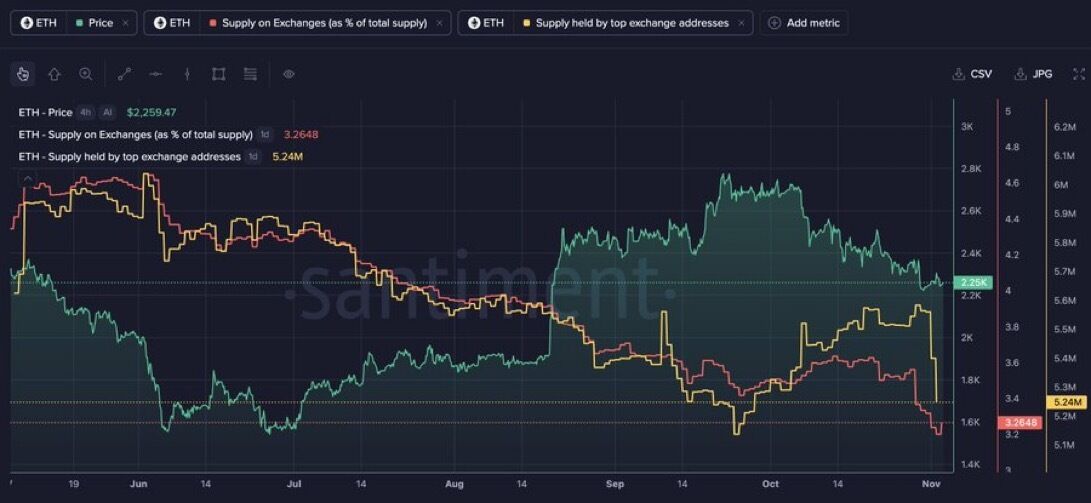
Ethereum's share of total supply held on exchanges fell from 3.56% on Oct. 28 to 3.20% on Nov. 2, a relative decline of about 10.1%, according to blockchain analytics firm Santiment. Roughly 313,000 ETH left major exchange addresses on Nov. 1–2 after withdrawals resumed, and those addresses shed about 297,000 ETH, or 5.4% of prior holdings, over the full reporting window.
The outflow traces back to the Oct. 29 attack on Binance's hot wallet. TRM Labs estimated attackers drained about 200,630 ETH, yet major exchange addresses actually gained roughly 39,000 ETH on the day of the breach, indicating the tracked decline came after withdrawal services were restored rather than at the moment of the hack. Santiment cautioned that exchange data cannot distinguish cold storage from transfers to other trading venues.
Prices did not firm alongside the falling balances. Ether traded near $2,259, still below its September highs, while bitcoin dipped to $76,268 before recovering above $77,700. U.S. spot bitcoin ETFs recorded net outflows of more than $1 billion across the Oct. 30 and Nov. 2 sessions. Lower exchange balances typically mean less immediately sellable supply, but thinner market depth can amplify price swings in either direction.
Exchange balances track where assets are custodied, not holder intent, so the shift does not by itself signal accumulation or distribution. Traders are watching whether ETH outflows persist alongside spot premiums and stablecoin net inflows to judge whether this is short-term risk aversion or a broader exit. Binance did not comment on the on-chain figures in these reports.
How this story unfolded
Earnings
Booking Q3 adjusted revenue tops estimates at $9.79B; GAAP revenue falls to $8.9B on $900M FTC charge
Adjusted and GAAP figures diverge, with the gap tied to a $900 million revenue hit linked to FTC action
Booking Holdings reported third-quarter 2026 adjusted revenue of $9.79 billion, above the $9.55 billion estimate and up about 9% year over year. Adjusted EPS came in at $4.66 versus the $4.50 estimate, up 17% year over year, while adjusted EBITDA of $4.61 billion also beat expectations.
On a GAAP basis, revenue was $8.9 billion, down 1% year over year and below the roughly $9.54 billion estimate; GAAP EPS was $3.61 and net income was $2.7 billion. Reuters reported the revenue decline was tied to a $900 million hit linked to FTC action.
Operating metrics beat: gross bookings were $54.5 billion versus the $52.69 billion estimate, and room nights sold were 345 million versus 339.24 million expected. The company guided to high single-digit adjusted revenue growth for FY26.
For investors, the key tension is between a one-time charge and core operating performance: adjusted profit and bookings exceeded expectations, while the GAAP revenue shortfall stemmed largely from the regulatory matter.
Apple (AAPL), Home Depot (HD) and GE Vernova (GEV) have objected to OKXICE's plan to trade tokenized versions of their shares, bringing the disclosed total of opposing issuers to 59, according to OKXICE public notices cited by Coin Bureau and Eleanor Terrett. The additions follow Monday's update, which added Amazon, Tesla, SpaceX, Netflix, SoFi and Lam Research and lifted the count from 50 to 56.
OKXICE is a joint venture between crypto exchange OKX and Intercontinental Exchange, the parent of the New York Stock Exchange. It plans round-the-clock blockchain-based trading of U.S. equities settled in stablecoins under the SEC's five-year innovation exemption introduced in September, which gives issuers 30 days from written notice to object. For companies notified on Oct. 4, that window fell around Nov. 3.
A CoinDesk tally found 49 of the 62 companies in OKXICE's original selection, about 79%, have now objected, along with seven firms outside that list. Apple's move means six of the Magnificent Seven have come out against the plan; Meta was not on the original list. Nasdaq warned issuers in September to be cautious about participating, arguing tokenized trading could fragment liquidity.
Andrew Cuomo, OKXICE co-chair and former New York governor, said at an Oct. 30 press conference that more companies would join as familiarity with tokenization grows, but he did not give a launch date or say how many stocks would trade at the start. The public notices do not detail individual companies' reasons for objecting.
CrowdStrike ships AI Kill Switch that cuts rogue agents off at the gateway
Falcon Guardian already watched enterprise AI agents since September; the new control adds a human-triggered stop, with endpoint termination still to come
CrowdStrike introduced its AI Kill Switch on November 3 at Fal.Con Europe 2026 in Barcelona, as a new control inside the Falcon Guardian platform and available immediately to its customers. When a security team activates it, connected AI gateways are directed to block the agent's access to the models behind its decisions and actions, relaunches are prevented and enterprise network access is revoked, with administrator actions written to audit logs.
The company's blog says the gateway can be CrowdStrike's own Falcon AI Gateway, now generally available and included with Falcon Guardian at no extra cost, or a third-party gateway a customer already runs. Direct termination of an agent on an endpoint is slated for a later release. Falcon Guardian itself launched in September to monitor AI agents operating inside enterprises.
CEO George Kurtz told CNBC that customers demanded CrowdStrike's protection before deploying Anthropic's Claude Cowork. CrowdStrike also announced deals to acquire agent-observability firm Fiddler AI and AI security testing firm Dreadnode, reported at a combined $495 million, expected to close in its fiscal fourth quarter of 2027.
Kurtz likened the control to airbags in cars, saying agents that step outside guardrails at runtime can be killed. CrowdStrike shares closed at a record $278.86 on October 6 and have since fallen about 12% as tech stocks weakened.
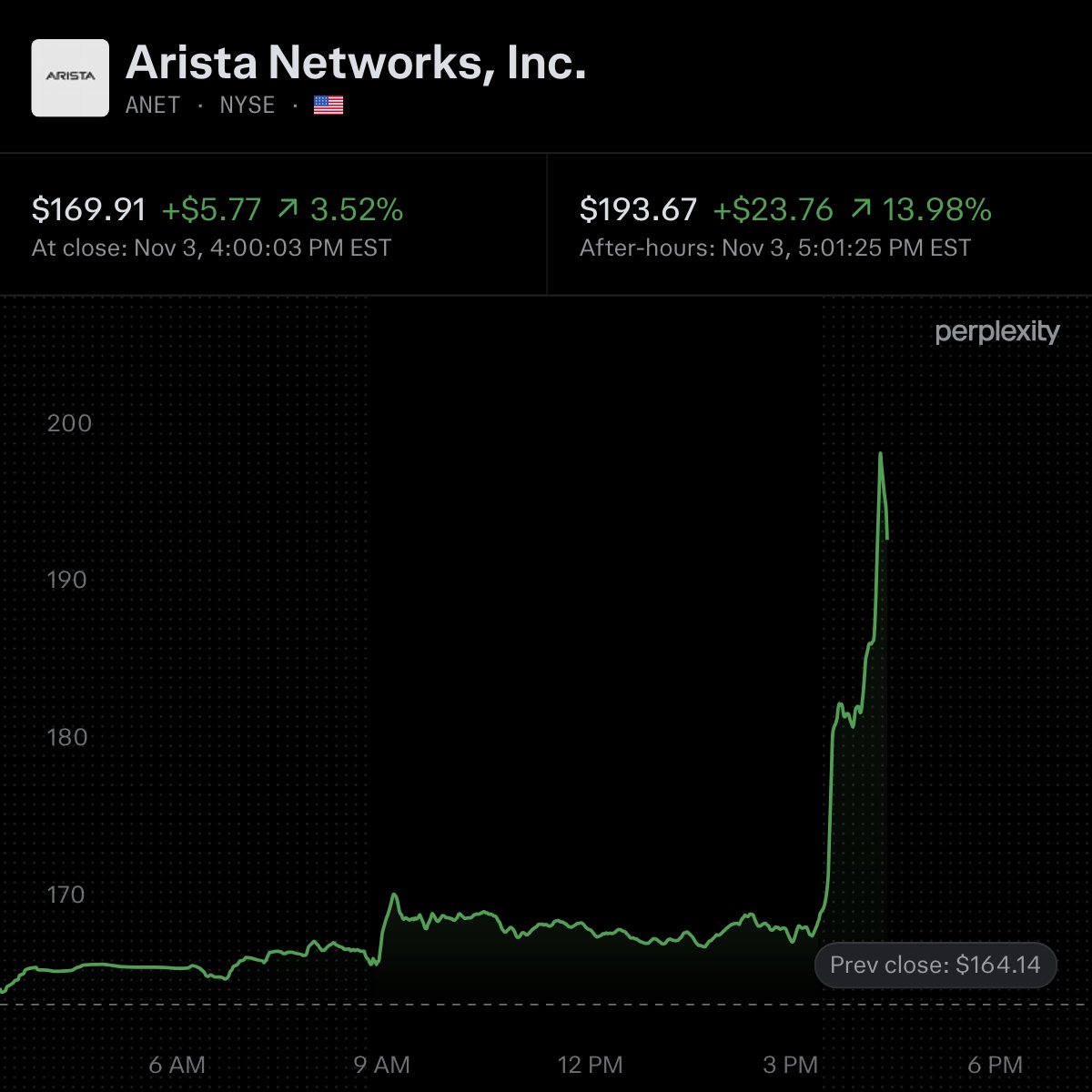
Arista Networks reported fiscal Q3 2026 revenue of $3.66 billion, above the $3.33 billion estimate and up 58% year over year. Adjusted EPS came in at $1.20 versus the $1.08 estimate, up about 58%. The company said it was its fastest revenue growth since going public in 2014.
Profitability improved alongside growth: non-GAAP gross margin was 64.0%, operating income $1.8 billion (up 60%), operating margin 49.1% and net income $1.5 billion (up 56%). For Q4, Arista guided revenue to roughly $3.9 billion-$4.0 billion, above the $3.6 billion estimate, with adjusted EPS of $1.26-$1.30 and a non-GAAP operating margin of 48%-49%.
Arista also announced progress on its Open Ethernet architecture and flagged rising investment in AI networking and liquid cooling. The stock rose about 18% after hours, with one quote showing $192.13, up 14.50%.
In our news library, Zacks recorded EPS of $1.20 against a $1.08 estimate; Benzinga reported the stock popping on the beat and strong Q4 guidance; fool.com noted gross margin slipped as product sales became a larger share of revenue. The company offered no additional comment in the materials.
Nvidia to deliver about 1% of $70 billion in China RTX Pro 5500 orders by year-end
Chinese AI firms ordered roughly 6 million export-compliant chips for inference, but supply constraints cap near-term shipments at a few thousand units
Chinese AI developers including Alibaba, Tencent and ByteDance have ordered about 6 million Nvidia RTX Pro 5500 chips worth roughly $70 billion, according to Bloomberg. Buyers expect only a few thousand units, about 1% of the order, by the end of this year, and roughly 700,000 units by the end of 2027.
The RTX Pro 5500 sits inside the export rules that bar Blackwell-based parts such as the B300 from China, so customers are buying it mainly for AI inference. Nvidia has acknowledged that production is struggling to keep pace with demand.
At a 1% fulfillment rate, the near-term revenue tied to the order is about $700 million against a $70 billion headline figure. The gap means Chinese cloud and model developers will see inference capacity expand on delivered units rather than signed contracts, while Nvidia's China demand stays largely unmonetized in the near term.
Separately, Barchart reported that Alibaba, Tencent and ByteDance are in talks with SK hynix and Samsung for long-term server memory supply, with SK hynix saying long-term agreements already cover more than half of its 2027-2028 capacity. Tightness in compute and memory supply is compounding.
Shopify reported third-quarter 2026 revenue of $3.74 billion before the bell on Nov. 3, up 31.6% year over year but just below LSEG estimates. Non-GAAP earnings came in at $0.49 per share, beating the $0.45 consensus. Shares fell about 9% after the results.
Bloomberg noted it was the company's first quarterly revenue miss in four years. Shopify president Harley Finkelstein told CNBC the quarter marked the sixth consecutive period of low-30s revenue growth, with Q4 guidance pointing to a seventh.
For the fourth quarter, Shopify guided to low-thirties percentage revenue growth, projected stock-based compensation of $155 million and a free cash flow margin in line with last year. Analysts cut their forecasts after the results.
The software sector tracked by IGV drew attention alongside Shopify, though the decline was concentrated in the company's own results and outlook.
ZachXBT names France's Crédit Mutuel Arkéa as suspected victim of $133M crypto theft
The bank confirmed a cyberattack involving fraudulent transactions but did not disclose the amount; funds moved through exchange accounts and were swapped into ETH
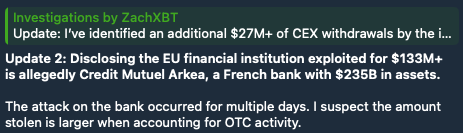
Blockchain investigator ZachXBT on Nov. 4 identified French banking group Crédit Mutuel Arkéa as the suspected victim of a crypto theft exceeding $133 million. He first flagged more than $106 million in suspicious withdrawals on Nov. 2, later found another roughly $27 million, and said the total could rise further once over-the-counter trades are counted.
Crédit Mutuel Arkéa confirmed the same day that it had suffered a cyberattack enabling fraudulent transactions, saying the incident was under control and that clients would face no financial consequences. It did not disclose the amount taken or how attackers gained access. The group has 5.8 million customers and €211.5 billion in assets.
Blockchain analytics firm Bitquery traced about $108.8 million in USDC withdrawn from Kraken, Crypto.com and OKX accounts over 21 hours on Nov. 1-2, much of it converted into ether across hundreds of wallets so a stablecoin issuer could not freeze it. Crypto.com said it blocked funds linked to the incident; Kraken said the incident did not originate on its platform, had restricted the accounts and was working with law enforcement.
ZachXBT said he had a high degree of confidence that North Korea's Lazarus Group was not behind the attack, citing differences in how the funds were moved. French media, citing a journalist and an unnamed source, reported the money may have exited through Fortuneo, Arkéa's online banking subsidiary, before being converted via accounts opened with false identities — a route not officially confirmed.
Marvell Technology is acquiring its laser supplier Lumentum in an all-stock deal valued at roughly $115 billion, according to X signals. TheStreet framed the transaction as Marvell giving up about a third of itself to buy the supplier.
The combination would pair Marvell's chips with Lumentum's lasers, giving one company a larger slice of the optical links inside AI data centers. TrendForce said the merger could challenge Broadcom's dominance in optical communications and reduce reliance on Broadcom by Nvidia and cloud giants; fool.com noted Nvidia CEO Jensen Huang had earlier called Marvell the next trillion-dollar company.
The market reaction has been severe. Barron's view, relayed on X, said the planned deal has erased more than $91 billion in the two companies' combined market value, though the selloff alone may not derail it. CNBC reported a BofA downgrade warning that Marvell could plunge on the multibillion-dollar acquisition.
On the legal side, the本站 news library shows investigations by Monteverde & Associates and Halper Sadeh LLC into whether Lumentum shareholders are getting a fair deal, while 247wallst reported that an overlooked supplier posted its best quarter after hours as both stocks fell.
Novo Nordisk reported third-quarter revenue of $11.91 billion on Nov. 4, beating expectations of $11.10 billion, up 6% year over year and 4% at constant currency. Adjusted operating profit came in at $4.77 billion, up 27% at constant currency, and the Danish drugmaker raised its full-year sales and profit outlook.
The raise was tied to sales of its Wegovy weight-loss pill, which posted DKK 5.39 billion in the quarter, and to an improved outlook for obesity and diabetes drugs, particularly outside the US. Obesity sales rose 22% at constant currency, and the company added about 1.3 million patients in the quarter.
Profitability lagged: adjusted EPS of $0.57 missed the $0.77 consensus. A separate signal cited adjusted EPS of $0.87 against an $0.81 estimate, a discrepancy investors should check against the official report. Falling US prices meant more medicine sold translated into little additional revenue.
Shares rose on the day as the guidance lift offered relief to a stock that has had a dismal year, though US pricing pressure remains the key overhang.
Kraft Heinz reported third-quarter 2026 adjusted earnings of $0.53 per share, beating the $0.42 consensus estimate. Net sales came in at $6.11 billion, slightly above the $6.09 billion expected, while organic revenue fell 1.0%, better than the 1.9% decline forecast.
The company raised its full-year adjusted EPS outlook to $2.07-$2.13 from $2.03-$2.09, and narrowed its organic sales guidance to a decline of 0.5%-1.0% from a prior range of 0.5%-2.0%. Its full-year adjusted operating profit guidance of a 16%-18% decline was left unchanged.
Kraft Heinz also said it will divest its North America coffee business while retaining a 30% stake, a move that sharpens its focus on core condiment and sauce brands.
Separately, the company named two new board members and declared a regular quarterly dividend of $0.40 per share.
SEC staff letter deems Canton Coin a digital commodity, sparing programmatic minting from registration
It is the first no-action letter of its kind since the SEC's March 2026 crypto interpretive release, giving institutions enforcement-level comfort on public-chain reward models
The SEC's Division of Corporation Finance issued a no-action letter dated Nov. 3 to Digital Asset, developer of Canton Network, stating that, based on the representations in its request, it views Canton Coin as a "digital commodity" and would not recommend enforcement action if Super Validators, Validators and application providers mint the token programmatically as described, without registration under Section 5 of the Securities Act or Section 12(g) of the Exchange Act. The letter was signed by Deputy Chief Counsel Jonathan Ingram and responded to a legal submission dated Oct. 30.
Staff leaned on two points: Canton Coin is intrinsically linked to and derives value from the programmatic operation of the network and supply-and-demand dynamics rather than expectations of profits from others' essential managerial efforts, and the network has no "central party" as defined in the interpretation. Digital Asset said the token had no initial coin offering or pre-mine sale and was initially earned only by operating network infrastructure and applications.
CC rose about 4% after the news to $0.098, though it was still down roughly 4.2% over the prior week. Institutional traction around the network includes DTCC's Oct. 28 launch of a tokenization service using Canton and private Besu infrastructure, with JPMorgan, Bank of America, Fidelity, Morgan Stanley and State Street participating; Bitwise listed a Canton ETP on Deutsche Börse Xetra under BWCC with a 0.85% expense ratio, and 21Shares introduced a similar product in the U.S.
The letter reflects staff's position on enforcement only and is not a binding ruling on CC's legal status, nor blanket approval for every transaction involving the token; different facts could lead to different conclusions. Staff previously issued token-related no-action letters to DoubleZero (2Z) in September 2025 and Fuse in November 2025.
Disney Plans Several Thousand Layoffs, Asks Some Managers to Cut Costs by Up to 20%
Latest round of cuts under new CEO spans TV, film and parks, about two weeks before earnings
Disney is preparing to eliminate several thousand jobs across the company, with some managers asked to target 20% in annual reductions from staffing and other expenses, according to Bloomberg. The cuts would span TV, film and parks.
It marks the latest round of job cuts since Josh D'Amaro became CEO earlier this year. The company has also promised double-digit growth in adjusted earnings per share this fiscal year, putting cost discipline alongside growth targets.
Barron's noted Disney shares are approaching their 52-week high, adding the reported layoffs as a new variable in the turnaround; a Yahoo Finance post said the stock rose after the report.
The plans come from people familiar with the matter; Disney has not publicly confirmed specific numbers or a timetable. Earnings are due in about two weeks.
TeraWulf said on Nov. 4 it signed credit support agreements with Google LLC covering debt financing for its Justified Data campus in Hawesville, Kentucky, which is leased to Anthropic under a roughly 401 MW, 20-year contract worth about $19 billion in contracted revenue.
The Anthropic lease was first disclosed in August on TeraWulf's second-quarter call, when management said it would be backed by an investment-grade credit without naming the counterparty. TeraWulf had contributed about $353 million of equity to the site as of June 30, including a $200 million land purchase.
The backstop is aimed at improving terms on project-level debt and limiting reliance on equity issuance; TeraWulf expanded its revolver to about $400 million in October. Google previously made $600 million of credit support effective for FluidStack's obligations at Lake Mariner.
Google did not disclose the size or structure of the support in the materials. TeraWulf also said it executed a definitive EPC agreement with Fluor, moving the project into construction.
Democratic candidates who campaigned on pausing data center construction won key races in Texas, Georgia and Ohio as midterm results came into focus on Nov. 4. In Texas, Gina Hinojosa defeated Republican Governor Greg Abbott, while James Talarico won the party's first Senate seat in nearly four decades, both backing a moratorium on new projects.
Texas is the largest data center market under development in the US. GLJ Research estimates the state accounts for about a quarter of US capacity due to come online by 2030, while Bloomberg puts its share of capacity under construction at nearly one third. Abbott had already paused permitting in late September, but the move did not stem the electoral backlash.
AI infrastructure stocks have been volatile. CoreWeave (CRWV) has halved over six months while carrying roughly $35 billion in debt against a $104 billion revenue backlog; Applied Digital, IREN and Nebius rebounded from a financing scare earlier this week. Analysts expect tighter state permitting to raise power costs, reduce tax breaks and push developers toward states such as Louisiana and Oklahoma.
Discussion on X was split: some users argued moratorium pledges are campaign rhetoric that will be diluted in office, while others noted that 87% of Republican voters also back restrictions and that building trades unions view the projects as a jobs boom. Democratic control of both chambers of Congress adds a further variable for AI legislation and Big Tech oversight.
Euro area annual inflation rose to 4.0% in October from 3.8% in September, Eurostat's flash estimate showed on Wednesday, the first reading at or above 4% since September 2023. Energy prices climbed 20.8% year on year, up from 18.9% a month earlier and the main driver of the headline increase; services rose 3.3%, food, alcohol and tobacco 1.6%, and non-energy industrial goods 1.2%. Core inflation, excluding those components, held at 2.5%.
National readings diverged: Italy's rate rose to 5.6% from 4.2% and France's to 3.8% from 3.4%, while Germany's fell to 2.8% from 3.3% and Spain's eased to 4.9% from 5.0%. Lithuania recorded the highest rate at 4.1% above the bloc average, at 6.1%, and every member state remained above the ECB's 2% target. The ECB held its key rate at 2.5% last month after a 25-basis-point increase in September.
Ahead of the release, markets priced a 71.8% chance of a hike at the ECB's final meeting of the year in December; after the data the implied probability was above 72%, and LiveSquawk cited traders putting the odds of a 25-basis-point move at nearly 85%. Bundesbank President Joachim Nagel said on Tuesday that a December increase is "very likely necessary from today's perspective," while Validus Risk Management's Robert Mertens cautioned that turmoil in the French bond market is constraining the ECB's room to act.
For markets, higher rate expectations typically support the euro and weigh on rate-sensitive bank and real estate valuations, but this inflation episode is energy-driven: Europe is a net energy importer and its price path is tied to Middle East developments. MUFG economist Henry Cook said in a research note that the longer the energy shock lasts, the more likely it is to feed through into wages and core inflation.
Jio Platforms, controlled by Mukesh Ambani's Reliance Industries, has held talks with Comcast and Charter Communications about licensing its wireless broadband technology in exchange for potential equity stakes, according to Reuters, citing two people familiar with the matter. No timetable has been set for a deal with any party, the sources said. Jio did not respond to queries; spokespeople for Comcast and Charter declined to comment.
The system runs on free, unlicensed Wi-Fi frequencies, beaming high-speed internet from towers or rooftop transmitters to receivers on buildings without cabling each home — a setup Reliance calls a "global first." Jio said last week it is targeting 10 to 15 partners worldwide. Earlier discussions with South Africa's MTN fell apart over valuation and certain licensing terms.
For Comcast and Charter, the appeal is cost: US cable operators are losing home broadband subscribers to fixed wireless and fiber. Comcast had about 28.3 million residential broadband customers at end-September and Charter about 29.4 million at end-June. Neil Shah of Counterpoint Research said spectrum is scarce and expensive, making an unlicensed approach potentially attractive to operators that would otherwise have to buy it.
Jio is India's largest telecom operator with more than 500 million subscribers and over 6.5 million UBR users, according to Reliance. The company listed in Mumbai last week after a $3.2 billion IPO. CEO Akash Ambani told analysts Jio wants to be a technology-led company abroad but will be "very, very selective" about which international markets it enters.
Binance was hacked with $5.7 billion in outflows across Ethereum, Bitcoin, and TRON networks, triggering over $1.3 billion in leveraged long liquidations.
2026-11-0114 posts · 9 authors
Binance restored withdrawals for select assets on the Ethereum network and BNB Smart Chain.
2026-11-027 posts · 4 authors
Community discussions focused on breach details, historical centralized exchange theft comparisons, and Google's Solana-based security initiative.
2026-11-0311 posts · 10 authors
Reports revealed the hack began with a fake job interview leading to malware, Binance reopened more withdrawals, and North Korea's potential role was highlighted.
2026-11-047 posts · 4 authors
The hacker continued swapping stolen SOL for BTC, while Binance detailed the attack as a months-long operation involving fake interviews and a compromised internal AI system.